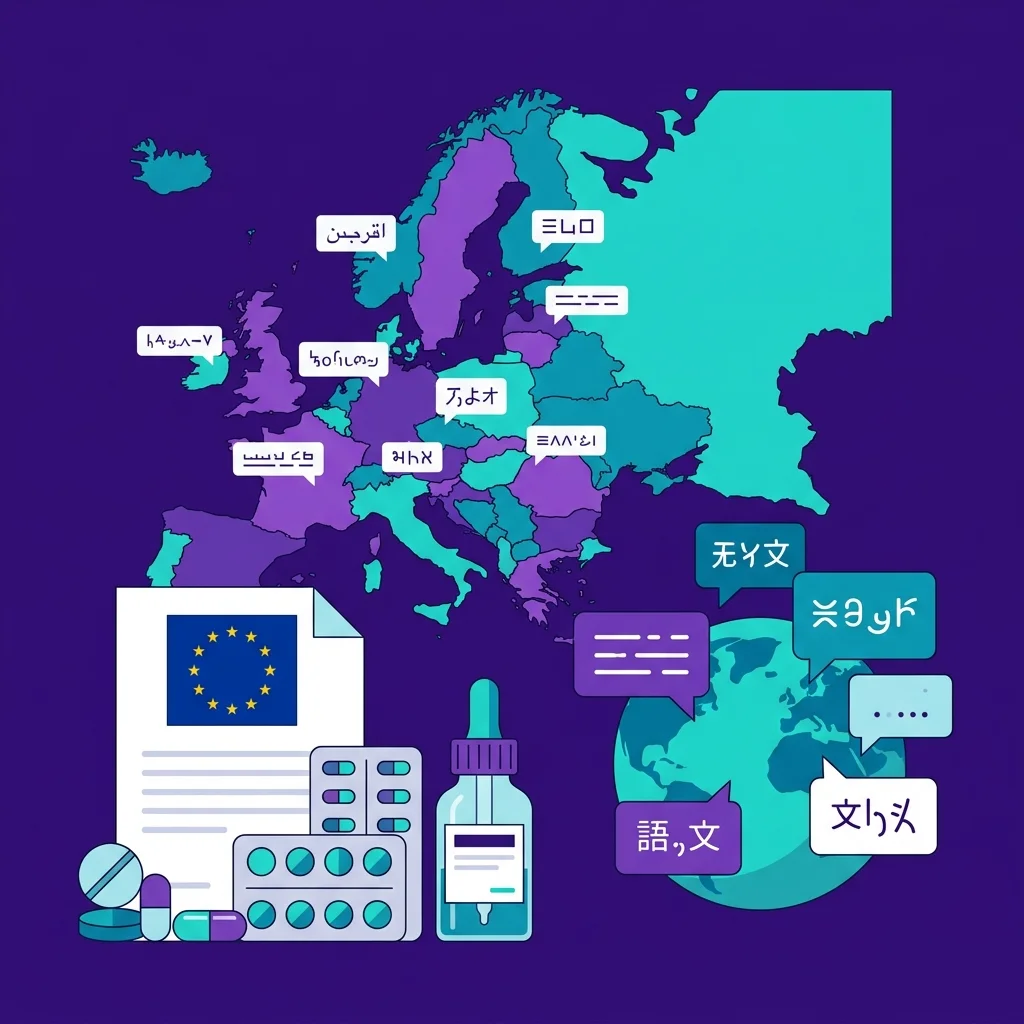
Which languages does the EMA require for pharmaceutical regulatory documents?
Which languages does the EMA require for SmPC, package leaflet and labelling? Country-by-country and procedure-by-procedure guide for RA teams.
Authorising a medicinal product on the European market immediately confronts Directors of Regulatory Affairs (RA) with strict linguistic complexity. Submitting regulatory documents to the EMA (European Medicines Agency) tolerates absolutely no approximation. A translation error or a linguistic omission during a filing invariably leads to the procedure being blocked, severely delaying the commercialisation of the therapeutic product.
For any RA Manager, successfully navigating the complex requirements of the centralised procedure (CP), the decentralised procedure (DCP), or the mutual recognition procedure (MRP) requires a perfect mastery of the specific prerequisites mandated by each member state. This comprehensive guide details the linguistic obligations dictated by the EMA, providing an exhaustive overview of requirements across European jurisdictions.
What are the official languages accepted by the EMA?
The European Union was built upon the fundamental principle of multilingualism. The EMA directly reflects this institutional model within its administrative operations and its stringent registration requirements.
The 24 official EU languages: a complete list
The European Union formally recognises 24 official languages, which constitute the solid foundation of any centralised authorisation procedure. When a product dossier involves all member states, the linguistic coverage required by the European Commission strictly encompasses this entire list:
* Bulgarian, Croatian, Czech, Danish, Dutch, English, Estonian, Finnish, French, German, Greek, Hungarian, Irish, Italian, Latvian, Lithuanian, Maltese, Polish, Portuguese, Romanian, Slovak, Slovenian, Spanish, and Swedish.
Irish enjoys full official status, whilst Icelandic and Norwegian (languages belonging to the European Economic Area - EEA) are additionally required for pan-European authorisations, even though they do not strictly belong to the core group of 24 official EU languages.
The EMA working language versus languages required for product documents
A fundamental distinction operates between the internal working language of the authorities and the language of restitution meant for the general public. Internally, the EMA and its scientific bodies (such as the CHMP) evaluate dossiers, operate, and draft their specific assessment reports exclusively in English. The pharmaceutical company therefore submits its clinical, non-clinical, and quality data within the eCTD (electronic Common Technical Document) specifically using English text.
Conversely, the final documents relating to the prescription and the delivery of the medicinal product must inevitably be transcribed into the official language of the targeted market in order to wholly guarantee local patient safety.
Which documents must be translated for a centralised marketing authorisation?
The centralised procedure (CP) permits a sponsor to commercialise their health product simultaneously across all EEA member states using a single marketing authorisation (MA). This immense legal uniformity naturally implies equally massive linguistic duties.
The SmPC, PIL, and labelling: mandatory translation in all 24 languages
The regulatory core imposed by the EMA comprises an inseparable trilogy of vital texts, frequently addressed in depth during comprehensive EMA marketing authorisation dossier translation operations:
* The SmPC (Summary of Product Characteristics), primarily intended for healthcare professionals.
* The package leaflet (PIL - Patient Information Leaflet), specifically designed for the end user.
* The labelling (covering both outer packaging and inner immediate packaging).
For any validated authorisation, these three documentary components are subject to strict translation into the 24 official EU languages, naturally alongside Icelandic and Norwegian (driven strictly by their EEA membership).
Annexes I to V: the linguistic scope and the QRD template
The EMA strongly standardises all translations by imposing an absolute adherence to the universally known QRD template (Quality Review of Documents). This strict reference model structures the formatting of all product information. The entirety of the authorisation annexes must obey this template and experience precise linguistic transposition:
* Annex I: The SmPC.
* Annex II: The overall conditions of the manufacturing authorisation.
* Annex III: The labelling and the package leaflet (PIL).
* Annex IV: Exceptional circumstances (if strictly required).
* Annex A: Specific conditions, amongst other elements.
Do the requirements change for a decentralised procedure (DCP) or MRP?
Unlike the centralised procedure, the decentralised procedure (DCP) and the mutual recognition procedure (MRP) target only a restricted fraction of European territory. Consequently, the linguistic obligation calibrates itself solely according to the precise member states involved in the filing.
The DCP: languages of the RMS plus each CMS
During a DCP, the pharmaceutical laboratory initially submits the dossier to a Reference Member State (RMS) responsible for the primary evaluation, acting jointly with the Concerned Member States (CMS). The language of submission for the technical dossier generally remains English. However, once the closure phase (Day 210) is reached, a national translation of the product information (SmPC, package leaflet, labelling) becomes strictly required to successfully validate the national legal decisions. Therefore, both the RMS and each selected CMS demand the transposition into their very own official state language.
The MRP: a language matrix mapped by recognition country
The MRP is designed for medicinal products completely granted a prior national marketing authorisation, which the sponsor now wishes to actively geographically extend. Upon launching the procedure, the summary originally approved by the initial competent authority will serve as the legal anchor. During the national phase following the successful conclusion of the procedure, the industry must confidently entrust the transcription of the SmPC and the PIL to specialised medical translation teams exclusively operating within every language representing the newly requesting countries.
Practical case study: a DCP filing across 8 countries, how many languages?
Assume a strategic deployment targeting a Swedish RMS accompanied by 7 CMS: Germany, Austria, France, Spain, Italy, Belgium, and the Netherlands.
The pharmaceutical sponsor will logically have to provide the SmPC, the PIL, and the required labelling in: Swedish (RMS), German (CMS Germany, Austria, and partially Belgium), French (CMS France, partially Belgium), Spanish (CMS Spain), Italian (CMS Italy), and Dutch (CMS the Netherlands, partially Belgium). Further local variations are added if a country legislatively imposes multiple national languages upon its official packaging. At this stage, the process becomes drastically complex.
What are the specific language requirements by European country?
The pharmaceutical sector must rigorously anticipate the unbending fact that certain countries house multiple national languages and impose highly precise legal constraints regarding the volume of languages tolerated upon a single package casing or within the leaflet. Here is a highly structured overview for fifteen critical European markets:
| Country | Language(s) required for SmPC | Language(s) for PIL | Specific notes |
| :--- | :--- | :--- | :--- |
| France (FR) | French | French | The ANSM accepts absolutely no other language for the patient. |
| Germany (DE) | German | German | The BfArM operates with stringent strictness regarding form and content. |
| Spain (ES) | Spanish (Castilian) | Spanish (Castilian) | Co-official languages (Catalan, Basque) remain purely optional. |
| Italy (IT) | Italian | Italian | The AIFA relentlessly demands exact restitution via standard Italian. |
| Portugal (PT) | Portuguese | Portuguese | Iberian Portuguese is exclusive (Brazilian Portuguese is wholly prohibited). |
| Netherlands (NL) | Dutch | Dutch | The CBG-MEB occasionally permits calculated multilingualism upon packaging. |
| Belgium (BE) | Fr/Nl/De (depending on agreement) | French, Dutch, German | The FAMHP enforces the three official languages upon the labelling. |
| Poland (PL) | Polish | Polish | Extremely robust local requirements regarding URPL specific phraseology. |
| Czech Republic (CZ) | Czech | Czech | Narrow linguistic tolerance for all formal SUKL documents. |
| Romania (RO) | Romanian | Romanian | The ANMDM demands that Romanian phrasing be flawlessly clear for patients. |
| Hungary (HU) | Hungarian | Hungarian | Translation via the OGYÉI undergoes a highly scrutinised semantic control. |
| Sweden (SE) | Swedish | Swedish | The Läkemedelsverket maintains its own exceptionally clear terminology conventions. |
| Denmark (DK) | Danish | Danish | The DKMA imposes the local QRD template format remarkably rigidly. |
| Finland (FI) | Finnish and Swedish | Finnish and Swedish | Fimea routinely requires total bilingualism across all marketed elements. |
| Greece (EL) | Greek | Greek | Compulsory utilisation of the Hellenic alphabet (EOF) without exception. |
| Bulgaria (BG) | Bulgarian | Bulgarian | Cyrillic alphabet is strictly mandatory; zero transliteration is legally permitted. |
What are the specific cases for the UK post-Brexit and Switzerland?
Certain highly strategic markets now evolve entirely outside the strict operational orbit of the European Medicines Agency, deeply implying a divergent linguistic treatment and oversight by wholly independent authorities.
UK/MHRA: Great Britain marketing authorisation, English solely
Since the finalised execution of Brexit, the Medicines and Healthcare products Regulatory Agency (MHRA) of the United Kingdom formally manages all health registrations natively. The specific Great Britain marketing authorisations are successfully obtained solely following the submission in English of the various strategic documents compiling the dossier. A degree of flexibility resides within the fact that the MHRA widely utilises the English pivot version solidly developed previously during overarching European procedures, which ultimately limits massively costly duplications.
Switzerland/Swissmedic: FR, DE, IT are unconditionally mandatory
In Switzerland, Swissmedic completely spearheads product evaluation independently from the EMA. The specific Helvetic particularity firmly resides in the quasi-systematic obligation (save for exceptionally rare cases successfully granted via derogation) to hold all information for professionals (the SmPC equivalent) alongside all information primarily for patients clearly formulated within the three official idioms of the nation: French, German, and Italian. Romansh remains formally excluded from the general, everyday regulatory landscape.
Does the SmPC always exist in an English pivot version in all cases?
During the organisation of the holistic commercial documentary workflow, the rigid consolidation of a master model text destined to serve as the absolute baseline remains the chief priority of all competent evaluation agencies.
The CP: yes, English is the indisputable reference
Within the stringent framework of the CP submitted directly towards the EMA headquarters, the authoritative drafting of the core document alongside its annexes is perpetually achieved in English. It is heavily based upon this specific pivot language text that product translations firmly align themselves, acting as an anchor in order to subsequently spread outward towards the comprehensive spectrum of all 24 official linguistic versions required by the European community’s structural system.
The national procedure: no, beware of specific filings where English is not the source
Conversely, occurring within a Mutual Recognition Procedure (MRP), if a medicinal product originally obtained a firm authorisation initially via the Spanish national agency (AEMPS) strictly drafted in Spanish, the Spanish file naturally constitutes the root text operating at the local plane. If the pharmaceutical sponsor ultimately wishes subsequently to shift entirely its marketing approvals rapidly onto neighbouring domains, the laboratory will regularly translate towards or actively lean upon a temporary transitional English version; thereby heavily inducing a highly meticulous linguistic exercise solely to entirely avoid severe interpretive distortions normally created dynamically via treacherous double translation mechanisms.
When do pharmacovigilance documents (PSUR, DHPC) need to be translated?
The complex post-market segment (continuous surveillance heavily following full commercialisation) triggers its ongoing continuous batch of strict linguistic updates actively imposed by the vigilant community legislator.
The PSUR: submission language to the PRAC
Periodic Safety Update Reports (PSURs) strongly concentrate the evaluation of the continuous benefit/risk ratio of any approved substance. Because these reports predominantly target European scientific evaluation authorities natively such as the PRAC (Pharmacovigilance Risk Assessment Committee), English typically functions alone as the single assessment idiom, excepting whenever an expressly localised request arrives punctually from an independently engaged national authority governing a specific jurisdiction.
The DHPC: compulsory local languages
In stark contrast directly opposite to the PRAC, a Direct Healthcare Professional Communication (DHPC) possesses the definitive vocation to physically or virtually land directly upon the desk of an active prescriber, a busy hospital ward, or a local practising registered nurse. Routinely ordered during cases witnessing the sudden discovery of notable adverse side effects, its immediate transmission is naturally pronounced as highest absolute priority. The EMA irrevocably stipulates that the DHPC must be flawlessly translated into the native local language of the severely targeted medical community so that they correctly comprehend it instantaneously, entirely rejecting the usual pivot English.
How do you manage product translation across 24 languages simultaneously?
Professionally managing over twenty distinct idiomatic pairs permanently requires robust technological infrastructures generally not possessed by a severely isolated Regulatory Affairs team operating internally.
Linguistic coordination, absolute consistency, and rigid deadlines
The much-feared "Day 210" alongside the subsequent stringent review phases executed by vigilant European hierarchical instances fix severe chronological commitments roughly hovering around five or seven hard-working business days strictly to submit the ultimate clinical textual rectifications identically across the entirety of the 24 languages. This unparalleled parallel coordination admits no randomness. This colossal legislative constraint successfully sheds any risk factor strictly when each operating stakeholder works actively upon a thoroughly secured framework exhibiting total GDPR-compliant document handling; ensuring that multiple disparate profiles effectively swarm optimally upon the identical draft of the package leaflet.
A centralised translation memory and fixed regulatory glossary
Scientifically recognised standard lexicons (such as MedDRA) flawlessly dictate the meticulously exact choice of any textual wording detailing highly adverse and deleterious side effects. By robustly maintaining a formal documentation memory operating through strictly unified software technologies, the heavily targeted vocabulary stays perpetually frozen securely across the lengthy product lifecycle. Thus, every single upcoming type II variation or subsequent medical indication extension functionally seamlessly semantically tunes perfectly with the deeply initial version flawlessly submitted roughly five years previously.
The strategic interest of a single multi-language focal point
The contractual implication of a highly capable professional translation agency adroitly equipped to intimately embrace 24 diverse languages simultaneously massively fluidifies an ecosystem typically tremendously heavy to orchestrate. Leading corporate RA directorates totally transfer the heavy burden of managing the frantic linguistic calendar, executing the structurally complex integrated Linguistic Quality Assurance (LQA) reviews, or strictly identically reformatting QRD templates effectively out-of-house; definitively guaranteeing that complex regulatory product approval thoroughly avoids remaining heavily stuck beneath the frustrating grip of purely intra-European syntactical obstacles.
What are the frequently asked questions regarding EMA language requirements?
Does the EMA accept purely English as a single language?Continually during the intense evaluation systematically run by the agency (reviewing scientific, quality, clinical, and non-clinical reports), strictly English successfully functions as the universally mandated default language formatting the precise eCTD. Nevertheless, exclusively pertaining to the critical prescription formulation, protective product labelling, and targeted patient directions, a single English version remains strictly and unyieldingly legally rejected: obtaining formal translation thoroughly across identically each language actively representing precisely the targeted commercial market continues to stand undeniably an absolute operational prerequisite operating inside Europe.
Must the SmPC be totally retranslated following every type of variation?Exactly whenever a specific variation (be it Type IA, IB, or a type II variation) becomes accurately filed fundamentally aiming to legally heavily modify existing active product information cleanly, solely those discrete textual blocks structurally heavily modified securely normally justify incurring an immediate linguistic update, which will strictly ultimately subsequently be cleanly systematically added onto the robust pre-existing core model base characterising the document. The technological updating systematically structurally operates optimally efficiently using strictly robust matching technological translation memories capable of recovering everything cleanly heavily previously existing.
Are regional languages (such as Catalan or Basque) heavily required?The EMA strictly mandates the use of standard established idioms that hold full independent national validation. Targeted packaging elements may, however, optionally incorporate a dedicated local regional variant (such as Basque or Catalan in Spain), provided this is explicitly permitted by corresponding regional authorities. This insertion is only acceptable as long as it does not obscure or compromise the clear veracity of the essential health information provided in the primary state language version.
---
Preparing an EMA filing in multiple languages? Send us your target country list and procedure type — we will come back with a detailed language plan and quote within 24 hours. EMA regulatory translation — quote request → Read next: EMA marketing authorisation dossier translation | How to choose a legal translation agency for cross-border litigationGet a Free Quote Within 1 Hour
Our specialist translators are ready to help. Response within 1 hour.
Get a Free Quote →Related Articles
EMA marketing authorisation translation: regulatory requirements and best practices
Translation requirements for EMA marketing authorisation dossiers: SmPC, PIL, QRD template, multilingual workflow. Best practices guide.

B2B transcreation: why translating is not enough for international marketing campaigns
Why translating your B2B marketing campaigns falls short. Real case studies, before/after examples, and the ROI of marketing transcreation for global businesses.