EMA marketing authorisation translation: regulatory requirements and best practices
Translation requirements for EMA marketing authorisation dossiers: SmPC, PIL, QRD template, multilingual workflow. Best practices guide.
Obtaining a marketing authorisation (MA) represents the culmination of decades of clinical research and substantial financial investment. For regulatory structures seeking to distribute their products across Europe, the European Medicines Agency (EMA) imposes extraordinarily rigorous protocols. Translating this MA dossier into the numerous European languages is not a mere post-approval formality; it is a pivotal task that dictates the operational deployment of the product, while ensuring the health and safety of future patients.
For Regulatory Affairs (RA) Managers within pharmaceutical laboratories, managing the linguistic transposition of this dossier requires scientific rigour and advanced project management. The slightest failure processing a specialised medical translation can significantly delay the availability of innovative therapies on the market.
What an MA dossier is and why translation is critical
The pharmaceutical industry has standardised its regulatory submission processes under the Common Technical Document (CTD) standard. Translation acts as the sole transmission mechanism between English-centric validation authorities and the medical realities of local healthcare professionals across Europe. The pharmaceutical and medical sector operates in an environment where linguistic ambiguity can result in severe consequences for patient safety.
CTD structure: modules requiring translation
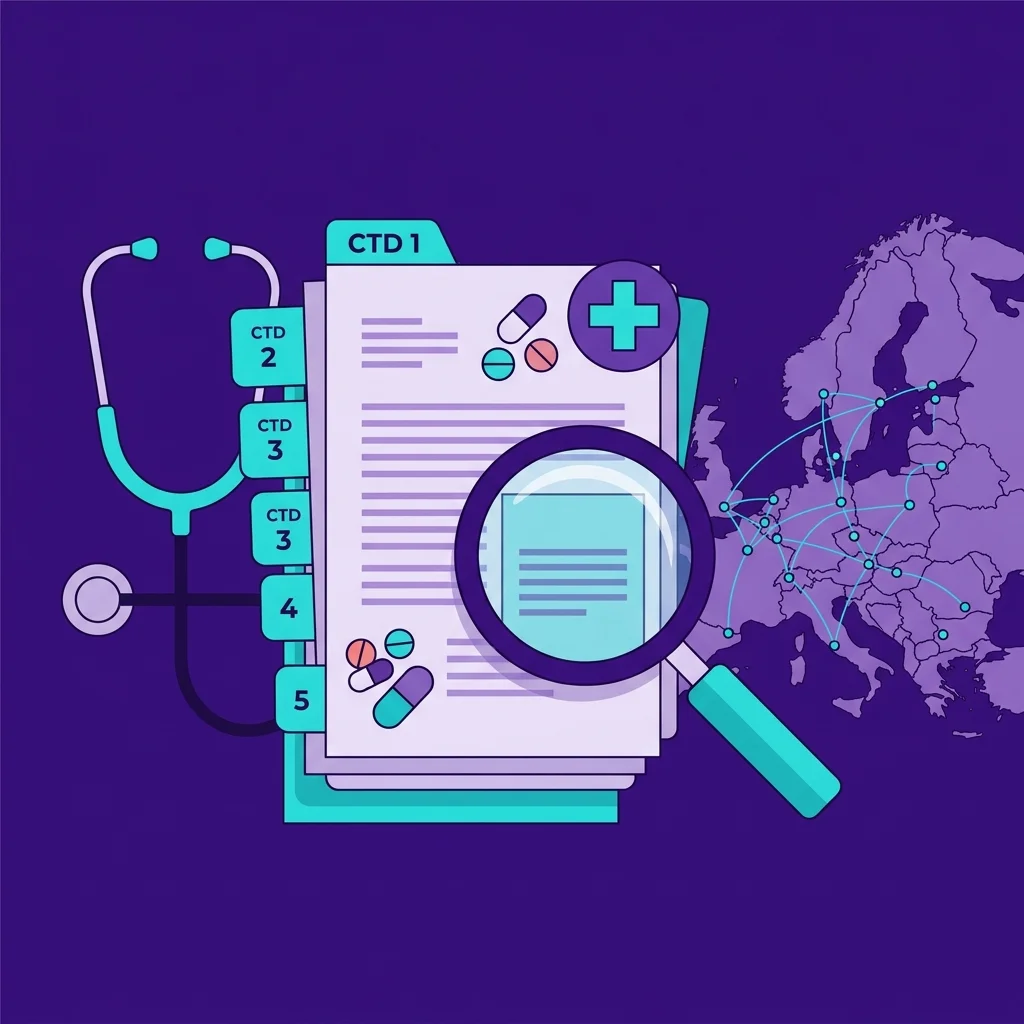
The CTD format, and by extension the electronic Common Technical Document (eCTD), is structured into five major modules that consolidate all scientific knowledge related to the product:
* Module 1: Administrative information and prescribing information.
* Module 2: CTD summaries (quality, clinical, and non-clinical data).
* Module 3: Quality data (manufacturing process, active substance).
* Module 4: Non-clinical study reports (toxicology, pharmacology).
* Module 5: Clinical study reports (human clinical trials).
While the majority of the clinical modules are routinely evaluated in English by the CHMP (Committee for Medicinal Products for Human Use) assessors within the EMA, specific subsets strictly require local translation during the final authorisation phase. Stringent management of GDPR compliant translation services is mandatory when exchanging clinical study data, even though such data is overwhelmingly anonymised prior to submission.
Module 1.3 (Product Information): the core of linguistic work
The absolute core of translation intervention targets Module 1.3, commonly designated as Product Information. This segment contains the formal documentation made available to practitioners and end-users. It is precisely here that regulatory pharmaceutical translation crystallises. Module 1.3 formally includes the Summary of Product Characteristics (SmPC), the Patient Information Leaflet (PIL), as well as both the outer and inner packaging details (labelling). Unlike the clinical reports in Module 5, which target exclusively scientific experts, the documents within Module 1 address a wide constellation of healthcare stakeholders. This inherently demands that the interpretation of the therapy is flawlessly adapted and entirely comprehensible across all target languages.
EMA language requirements: centralised vs decentralised procedures
The institutional framework of healthcare agencies provides pharmaceutical companies with various strategic pathways. The implications regarding linguistic requirements and timelines vary considerably.
Centralised Procedure (CP): English as the pivot language, then translations into all official languages
The centralised procedure (CP) is mandatory for medicines derived from biotechnology, orphan medicinal products, and advanced therapy medicinal products. It allows companies to access the entirety of the European Economic Area market simultaneously. During the scientific evaluation phase (Day 1 to 210), the sole language of communication is English; consequently, English functions as the pivot language. Once the central document achieves validation, the applicant enters a race against the clock: within a few working days, they must provide meticulous translations of Module 1 into the 24 official languages mandated by the EU. The scheduling pressure is intense given the economic stakes of launching a new therapy.
Decentralised Procedure (DCP) and Mutual Recognition Procedure (MRP): RMS and CMS languages
Conversely, stakeholders choose to introduce generics via the decentralised procedure (DCP) or the mutual recognition procedure (MRP). In a decentralised procedure, the applicant selects a Reference Member State (RMS) that will pilot the initial scientific evaluation in strategic cooperation with several Concerned Member States (CMS). From a linguistic perspective, the documentary arsenal does not have to cover 24 distinct languages. The requirement is strictly reduced to the specific EMA linguistic requirements country by country applying strictly to the chosen RMS and to the various CMS involved. This mechanism partially alleviates the logical flow of translations but does not in any way minimise the scientific excellence expected for each translation produced.
The QRD template: mandatory framework and translation constraints
To standardise presentation and streamline information for the public, the Quality Review of Documents (QRD) panel has forged an immutable structural convention. Translators must adhere to this template with draconian obedience.
Imposed structure and unalterable passages
The QRD template defines the formal nomenclature that governs all SmPCs and package leaflets. Available for download from the EMA for almost all continental languages, the template consists of mandatory section headings, standard cross-references, and sometimes very specific predetermined formulations. During target language drafting, the regulatory translator has no authority whatsoever to innovate, modify, or paraphrase the foundational vocabulary established within the base template. Standard regulatory formulations must precisely match the EMA's official document word-for-word. This forms the very essence of linguistic compliance orthodoxy.
Translation pitfalls within a fixed template (layout, codes, annotations)
Importing raw text into the QRD template generates substantial layout complications. This skeleton is abundant with bracketed annotations, cryptic administrative codes, versioning instructions, and specific margins that must be observed minutely. Any agency involved must handle this format in a manner that preserves the inviolability of headers or protected titles. The critical risk for a Regulatory Affairs department is receiving a translated dossier that fails to respect the exact margin template required, precipitating administrative corrections during compilation. Thorough structural scrutiny is therefore a paramount necessity to avoid severe regulatory delays and ensure the technical viability of the final submission package presented to the national competent authorities across Europe.
SmPC, package leaflet (PIL), and labelling: document specifics
Although they constitute the three structural pillars of the dossier, each component holds a specific function and consequently demands a distinct linguistic register tailored precisely to its target audience.
SmPC: high precision medical terminology, consistency with approved source text
The Summary of Product Characteristics (SmPC) acts as the definitive descriptive manual intended purely for healthcare professionals: pharmacists, hospital specialists, and prescribing physicians. The requirement focuses on translating every pharmacokinetic or pharmacodynamic mechanism with absolute meticulousness. Any literary extrapolation is strictly prohibitive. What is required is a millimetric terminological alignment with MedDRA terminology and the pharmacopoeia of each Member State, because the SmPC crystallises the legal scientific authority for the treatment.
Package leaflet (PIL): mandatory readability (user testing) and adapted register
At the opposite end of the human interface sits the Patient Information Leaflet (PIL). Its primary role aims to transform medical complexity into a tangible, accessible instruction for the suffering patient. The linguistic register must shed its excess technicality, moving towards a reading experience that is clear and reassuring, yet absolutely unequivocal regarding contraindications. Regulatory authorities enforce an external evaluation regarding practicability, referred to as User Testing or Readability Testing. A sentence translated too complexly risks being rejected during its evaluation by a panel of test patients.
Labelling: space constraints, regulated abbreviations, multilingual packaging
The third branch of the translation paradigm involves streamlining the labelling (inner packaging and outer carton). Subject to insurmountable topological limitations, the translator must produce content that is brief, incisive, and fully compliant with regulations. Many pharmaceutical corporations opt for multilingual packaging to centralise their productions for diverse regions, such as the French-Belgian-Dutch cluster. Managing character volume becomes a cardinal concern, knowing that expansive text cannot stretch exponentially across the packaging box, dictating extensive work on rendering concepts effectively through validated acronyms.
Variations, renewals, and PSUR: the post-MA lifecycle
Approval by the European Commission does not signify the end of linguistic complexities. It triggers the onset of a permanent regulatory periodic cycle.
Maintaining terminological consistency over 10+ years of updates
From the moment of homologation, the post-marketing phase commences. Clinical variations (Type IA, IB, or major Type II variations requiring prior approval), ten-year renewals, or regulatory submissions inherent to Periodic Safety Update Reports (PSUR) mark the trajectory of every medicine. Conserving linguistic stability decade after decade constitutes a labyrinth for compliance affairs. It necessitates the systematic deployment of CAT (Computer-Assisted Translation) software and rigorous centralised processes. This guarantees that a clinical description originally validated in Spanish is reproduced exactly the same way to feed a subsection of a major variation fifteen years later, allowing auditors to rule rapidly. Additional materials like Direct Healthcare Professional Communications (DHPC) and PRAC (Pharmacovigilance Risk Assessment Committee) safety reviews also demand equivalent linguistic precision.
Project management: structuring dossier translation across 20+ languages
Ensuring the synchronised delivery of over twenty transcriptions of a master file within strict deadlines requires deploying top-tier multilingual governance solutions. The operational director must master any form of temporal friction during this chronological sprint.
Translation memories and RA-approved terminology glossaries
The prelude to such complex projects is organised by the meticulous creation, in collaboration between specialised linguists and the Regulatory Affairs department, of corporate glossaries and approved lexical databases (Translation Memory, or TM). This library encompasses the names of approved indications, formulary excipients, and all standard definitions of adverse or contraindicated interactions previously validated by accredited national bodies to block uncertainty. Without these intangible foundations centralising professional translation, any recurring phase incurs the definitive risk of cross-inconsistencies that ruin the quality of homologation.
Parallel vs sequential workflow: balancing deadlines, costs, and quality
The drafting timeline proves challenging on projects of staggering scale. A sequential strategy would wait for the final approval of the control authorities (the CHMP) to simultaneously launch all variations. This clashes with restricted post-opinion submission constraints (Day 210 post opinion timeline). Many structures implement highly parallel workflows: commencing the linguistic aspect during the submission pre-confirmation phase, and iteratively processing waves of minor final amendments before definitive publication, ensuring no hours are lost.
Back-translation: when it is required and how to organise it
The use of retrospective translation, more commonly termed back-translation, belongs within the register of highly regulated precision certification. It is accomplished by taking a version previously converted into a target language, and assigning it to a third-party linguistic team that has never viewed the source materiality of the original document. Their assigned role consists of reconverting the output back into the native arena of the source text. RA teams can then objectively assess the accuracy of the transfer. This approach, lengthy and extremely meticulous, is sometimes imperative during clinical protocols or for serious warnings involving major alterations to the PIL in order to prevent severe clinical repercussions and consumer litigation.
Common errors and regulatory risks
Translation errors within a European approval dossier assume colossal systemic dimensions, immediately impacting the overall pharmaceutical efficiency of distinct Member States.
Inconsistency between language versions: the referral procedure nightmare
One of the most formidable complications facing any RA department is the regulatory phenomenon known as the referral procedure. Should it be detected—even long after the licence is initial granted—that a fundamental semantic disparity betrays the core prescribing indications between a package leaflet in Poland and its formal counterpart in Latvia due to a reviewer's incompetence, the institutions will inevitably demand the arduous opening of an investigatory referral procedure for interstate arbitration to harmonise these indications. This constitutes an intolerable financial escalation with disastrous consequences.
Translating posology and measurement units: errors impacting the patient
At an even more surgical level than the global text lies the highly precise treatment of the administration scale. Erroneously substituting a decilitre for a centilitre, or clumsily transcribing a microgram (mcg) dosage system due to interpreting an incorrectly decoded symbol, results in a fatal disruption that irreversibly affects human lives. Semantic errors are frequently responsible for major adverse events due to overdosing, generating a systemic scale with devastating parameters. Human error during the transliteration phases dictates the exclusive presence of certified translators for these domains of excellence.
Criteria for selecting a pharma regulatory translation agency
Considering the outsourcing of the massive volumes inherent to MA obligations strongly binds the operational credibility of a manufacturing company. The technical requirements incumbent upon the future provider surpass the standard thresholds expected of consumer supply chains.
Specialised pharma translators vs general medical translators
A fundamental error during the selection phase resides in the inability to distinguish between a bilingual physician and an EMA regulation specialist. Knowledge of surgical medical corpus absolutely does not guarantee knowledge of the structural bases codified by Brussels concerning the presentation of CTD Module 1 variations or the perpetual doctrinal evolution of MedDRA. It is imperative to base choices on a verified history of mastery regarding the drafting of official standards governed by strict community laws.
Capacity to absorb 24 languages simultaneously with a single point of contact
Equally critical, the cardinal asset remains synergy. The inability to orchestrate an imposed pace across a multitude of languages represents a bottleneck for the majority of very small independent structures. By opting for complete centralisation around the appointment of an expert RA project manager across all assigned batches, regulatory entities avoid terrifying documentary logjams. This approach maintains an unshakeable schedule, uniformly propagates all nuances correctly, and ensures the overall efficiency of multi-territory filings through automated consistency checks. Providing unified governance guarantees absolute technical alignment and a streamlined response to complex legislative modifications introduced throughout the product's extended commercial lifecycle.
Frequently asked questions about MA dossier translation
Q1: Does the EMA accept machine translations for these dossiers?Although the Agency utilises neuro-computing capabilities for its own internal understanding, it is strictly banned for medical industry entities to employ uncalibrated automation that is not comprehensively re-correlated through the surveillance of specialist reviewers. Raw machine output within human product leaflets visibly endangers patients and will ruthlessly lead to the unconditional rejection of the application.
Q2: Must the entire SmPC be re-translated during a type II variation?No. The initial documentation is maintained, and the textual body amendment is judiciously limited to the section specifically affected by the scientific novelty (such as the chapter dealing with precautions, undesirable effects, or altered pharmacokinetics). This requires fully capitalising on the original approved translation using advanced translation memory (TM) software. This technology serves as a persistent semantic referencing tool, effectively preventing discrepancies and significantly reducing invoicing costs.
Q3: How can consistency be guaranteed across 24 languages simultaneously?This is fundamentally cemented upon translation memory systems and corporate terminology glossaries parametrised to eliminate inconsistent word choices. The process is seamlessly enforced by deploying a centralised workflow controlled by a single operational contact point. Rigorous quality assurance checks hunt down imperceptible omissions, guaranteeing the European assessor that the Danish, Polish, and Latvian documents will simultaneously issue scientifically identical posological instructions.
---
Preparing a centralised or decentralised marketing authorisation dossier? Send us your Product Information and target language list — we will come back with a structured plan and quote within 24 hours. MA dossier translation — quote request →Get a Free Quote Within 1 Hour
Our specialist translators are ready to help. Response within 1 hour.
Get a Free Quote →Related Articles

B2B transcreation: why translating is not enough for international marketing campaigns
Why translating your B2B marketing campaigns falls short. Real case studies, before/after examples, and the ROI of marketing transcreation for global businesses.
How to choose a legal translation agency for cross-border litigation
How to select a legal translation agency for cross-border litigation: criteria, red flags, checklist. Practical guide for in-house counsel.