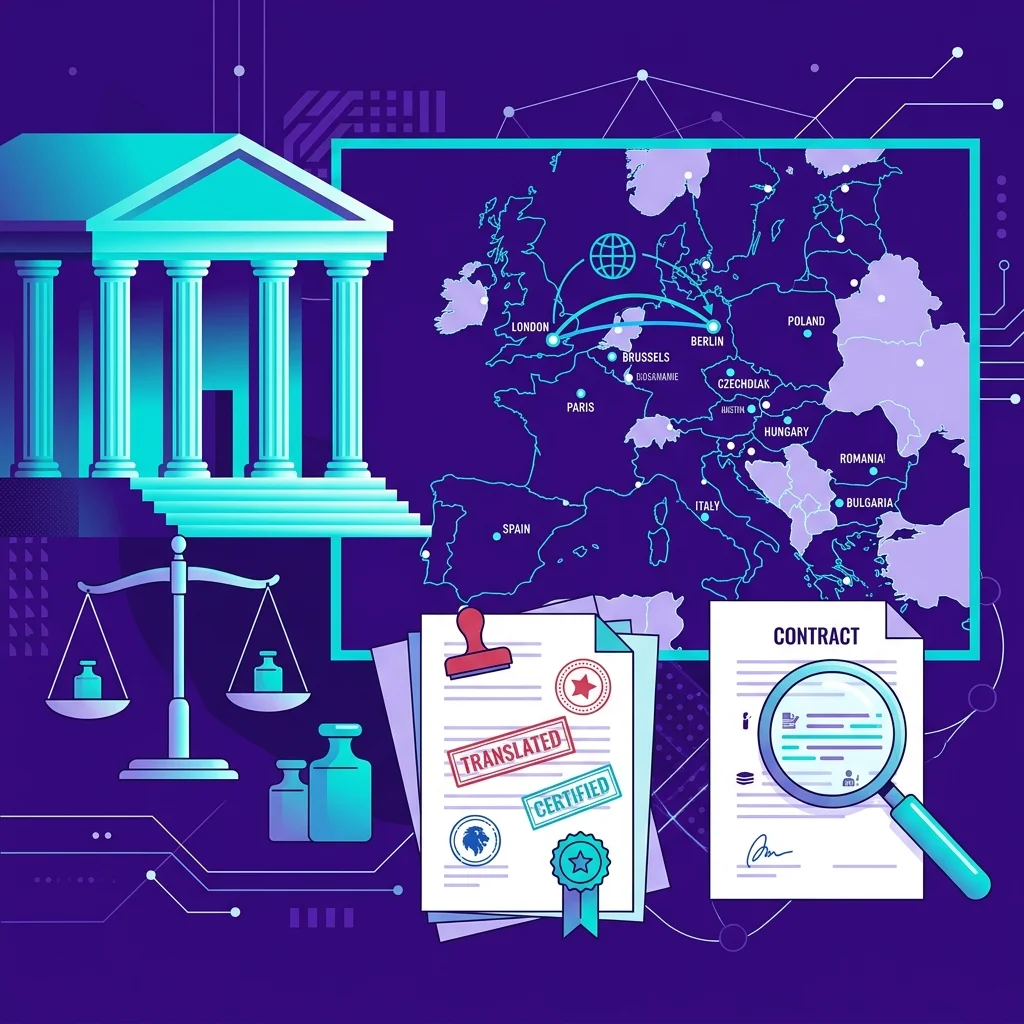
How to choose a legal translation agency for cross-border litigation
How to select a legal translation agency for cross-border litigation: criteria, red flags, checklist. Practical guide for in-house counsel.
Litigation involving parties from different European jurisdictions imposes absolute documentary rigour. When a dispute arises, whether concerning a breach of contract or an intellectual property infringement, the entire case rests upon written evidence. Retaining a specialised legal translation agency for international litigation is not merely a linguistic exercise; it operates as an active component of your defence strategy. This comprehensive guide details the objective criteria required to evaluate an agency's competence, the formal requirements mandated by local jurisdictions, and the major procedural pitfalls to avoid in order to safeguard your case from the initial compilation of court documents through to the final judgment or arbitral award.
Why does cross-border litigation require a specialised provider?
Given the urgency dictated by judicial proceedings or arbitration tribunals, linguistic misrouting is strictly impermissible. Entrusting sensitive court documents to an unspecialised provider places the outcome of the litigation in extreme jeopardy.
The difference between standard legal translation and litigation translation
A vast chasm exists between translating corporate articles of association or general terms and conditions of sale, and tackling the translation of a writ of summons, written pleadings, or an expert report. Standard legal translation focuses on conveying information and ensuring contractual fluidity, typical of French-German commercial contract translation where parties establish amicable rules. In the context of litigation, however, every comma, every adverb, and every nuance is weaponised to attack or defend. The translator acts as an extension of the partner's legal strategy: a simple distortion regarding the burden of proof or a specific breach (for instance, translating "faute" as merely "fault" versus "gross negligence" depending on context) fundamentally alters the judge’s interpretation. For this specific reason, a legal translation provider strictly dedicated to disputes is indispensable.
The consequences of flawed translation before a court or arbitrator
A magistrate or an arbitrator does not scrutinise the original document in its foreign language; rather, they base their entire analytical process on the translated submission. The consequences of any failure are formidable. Should the translation of a piece of evidence be deemed imprecise or equivocal, opposing counsel will relentlessly introduce procedural incidents to challenge its admissibility. Beyond procedural delays—which upset the schedule and necessitate the appointment of a new expert to re-translate the files—the entire credibility of the presenting party deteriorates. Before European courts, having evidence excluded from proceedings (inadmissibility of evidence) frequently culminates in the dismissal of claims and substantial financial ruin associated with the cross-border litigation.
What objective criteria should you verify before retaining an agency?
Choosing a linguistic partner must not rely on instinct or solely upon securing the cheapest quote. Factual, verifiable criteria must dictate your selection for a case potentially involving millions of euros.
Specialisation in law: litigation, arbitration, IP, and corporate law
A general mastery of "the law" does not exist for translators, just as it does not exist for lawyers. It proves critical to test the agency systematically regarding its capability to target hyper-specialised linguists. Litigation concerning execution acts in violation of patentability will demand experts thoroughly comfortable with European patent translation. Conversely, a post-acquisition shareholder dispute will require a translator deeply familiar with M&A, shareholder agreements, and corporate litigation, possessing full command of the jargon surrounding severance pay or liability guarantee clauses.
Verified experience with the targeted jurisdictions (national courts, ICC, CJEU)
Every judicial chamber and legal system enforces tacit rules and a distinct drafting style. Written pleadings destined for the Court of Justice of the European Union (CJEU) in Luxembourg possess writing codes that are profoundly different from those expected by the International Chamber of Commerce (ICC) in Paris during an arbitration, or by the High Court of Justice in London in a post-Brexit context. The chosen partner must actively illustrate their working knowledge of the procedural rituals and customary typography expected by these specific jurisdictions to ensure the final document naturally integrates into the court’s processes.
Scalable capacity to process high volumes under judicial deadlines
Cross-border litigation frequently necessitates the rematerialisation or extraction of data rooms comprising thousands of pages: email communications, audit assessments, and technical reports. The linguistic partner must definitively demonstrate their operational capacity without sacrificing homogeneity. This scalability is assessed by the magnitude of the translator pool that can be mobilised urgently, alongside the agency’s technological capability to purge repetitions from case files using professional Computer-Assisted Translation (CAT) tools. This guarantees drastic time reductions between the order to produce documents and their final filing with the registry.
Should the agency provide certified or sworn translations?
Depending on whether you are submitting your briefs during a private arbitration or before a state court, the requirement for a certified translation frequently imposes itself as an unavoidable hurdle.
Certified versus sworn translation: what differs in a litigation context?
A free, uncertified translation does not contractually bind the translator before a jurisdiction. Conversely, procuring a sworn translation (also known as a certified translation in some jurisdictions) signifies that the final document possesses the equivalent legal weight of the original, because it is validated by an expert translator officially registered on a judicial list (in France, appointed by a Court of Appeal). This distinction ensures that the impartiality of the transcription remains legally unassailable. However, not all European countries operate under the "sworn expert" system. Certain nations apply a logic based on notarial certification or regional court stamping, a complexity detailed in the article covering sworn translation in Europe and country requirements.
Which European courts require what: a comprehensive summary
To streamline the preparation of your bundle of court documents, the following table summarises commonly applied practices:
| Targeted Jurisdiction in Europe | Translation Certification Requirement | Notes on Local Procedure |
| :--- | :--- | :--- |
| France (Tribunal judiciaire, Court of Appeal) | Highly mandated (Sworn translation) | An original stamp and signature from an expert translator appointed by the Court of Appeal are mandatory. |
| Germany (Landgericht) | Strongly recommended (Beglaubigte Übersetzung) | Executed by a "vereidigter Übersetzer," often indispensable for evidentiary documents (Beweismittel). |
| ICC Paris (International Arbitration) | Generally uncertified (unless stipulated otherwise) | English or French formats are acceptable, yet absolute terminological equivalence is demanded by the arbitrators. |
| CJEU (Luxembourg) | Uncertified but strictly regulated formally | Pleadings are filed freely if the procedural language permits, though certified translations accelerate appellate reviews. |
| Belgium (Tribunal de l'entreprise) | Sworn translation required | The translator’s registration on the Belgian national register is formally required (or a European apostille equivalent). |
| High Court London (Post-Brexit) | Statement of Truth required | There is no "sworn" status; rather, the translator must produce an affidavit certifying truthfulness under oath. |
Before retaining a provider, consult our comprehensive guide to certified legal translation in Europe to proactively anticipate these frequent, last-minute procedural blockages.
How can you evaluate confidentiality and data security?
Placing confidential evidence, fully protected by legal privilege, into the hands of a third-party service provider demands an infrastructure completely opaque to the rest of the market.
Case-specific NDAs versus generic privacy policies
Clauses lazily inserted into standard general terms and conditions of sale are vastly insufficient when dealing with high-stakes cross-border litigation (breach of agreements, trade secrets, supplier lists). The agency must proactively offer a strict confidentiality agreement (NDA) that explicitly targets the case code name or the root of the dispute ("Project Alpha"). This agreement must jointly bind the agency, the project manager, and every individual translator and proofreader deployed to work on your submissions.
Stringent technical infrastructure: encryption, restricted access, traceability
Disregard operators proposing transfers via generic email inboxes. The selected provider must prove the existence of a sovereign European infrastructure, employing secure servers that comprehensively prevent the extra-community transfer of your sensitive data (in strict adherence to the GDPR). The storage of evidentiary documents must exclusively occur on encrypted portals featuring comprehensive logging of access times. Absolutely no indefinite retention of files is permissible following the restitution and final sign-off of the requested mission.
Do you need a single point of contact or a dedicated team?
The human resources organisation operating within the translation agency directly influences the success of your judicial schedule. The fragmented approach adopted by low-cost agencies invariably leads to disaster.
The legal project manager: the pivotal link between lawyer and translator
The profile you must seek first is not the translator themselves, but the Project Manager (PM) who will oversee the transversal dossier. This is the exclusive point of contact for the law firm or in-house counsel. With a background in law, the PM analyses incoming documents (affidavits, writs, summonses), constructs strategic briefings, and allocates tasks to the pool based precisely on the strict imperatives of injunction schedules or substantive hearings. This pivot filters queries from the team and homogenises critical decisions (for example, achieving consensus on the definitive translation of a heavily litigated term). Any serious agency provides a direct communication line to the specific PM responsible for the account.
Terminological continuity across a multi-document case file
A dispute is never resolved through a single ten-page document; rather, it unfolds across prolonged series of submissions, rejoinders, technical notes, and appended reports. The dedicated team must deploy an unalterable translation memory, empowering them to freeze the lexicon as the case evolves over months or years. This highly structured methodology guarantees absolute terminological alignment across exhibit #1, exhibit #45, and exhibit #112.
What are the realistic timeframes for translating court documents?
Waiting until the eve of a registry deadline to initiate a translation mission is a customary practice within the legal sector, yet realistic planning remains necessary.
Factors influencing variability: volume, language pairings, technical complexity
A legal translator of supreme excellence is capable of processing between 2,000 and 2,500 words per daily cycle to ensure a sufficient documentation and research phase. Deadlines immediately vary if additional parameters compound the difficulty. For instance, locating five hyper-specialised professionals translating from Danish into Spanish for an arbitration is infinitely rarer. It will induce delays if the casting is not mapped out in advance, compared to the heavily dominated French-English segment where execution capability is often immediate.
Urgent translation for injunctions or interim measures: what should you anticipate?
When an interim measure falls upon a client (such as an anti-counterfeiting seizure or asset freeze), or a criminal summary proceeding relies on a timeframe of mere hours, the mechanics of urgent translation activate. Industry experts can then process the workload in asynchronous slices. Faced with this high-pressure scenario, the instructing partner must immediately provide the agency with a triage nomenclature identifying the "key exhibits" (those requiring immediate proofreading and delivery within 12 hours) as opposed to less strategic annexes. This allows the agency to construct a partial, phased delivery flow seamlessly.
How can you avoid the most costly errors?
When entrusting a vital case to a third-party company, various behavioural signals must instantly prompt the lawyer or in-house counsel to sever all contact.
The 5 red flags that must alert any legal professional
- Automated quoting without document analysis: The agency offers no evaluation regarding technicality and fails to propose a prior NDA.
- A total absence of displayed "litigation" specialisation: This signals an opportunistic provider desperately lacking the prerequisites.
- Unclear identification of proofreading processes (no cross-checking): The agency merely advertises a unitary "per word" rate without detailing any rigorous quality review mechanisms.
- Incapacity to assign a dedicated Project Manager: You are left navigating between customer service and billing departments, facing constantly rotating personnel.
- Total ambiguity regarding data hosting or servers: There are zero GDPR guarantees, and undisclosed transfers to external or non-European cloud services occur.
The deadly trap of un-proofread machine translation for written pleadings
It occasionally proves tempting to cut expenses by advancing solely via machine outputs. This perilous illusion is analysed in greater depth here: DeepL vs Human: why does the legal sector block AI?. Placing raw artificial intelligence translation directly into your "written pleadings in defence" equates to procedural suicide. The machine aggressively smooths out nonsense and behaves statistically: it overrides the deliberate ambiguity of complex syntax, radically altering the specific contractual anomaly the lawyer is attempting to meticulously highlight before the court.
What questions should you ask during the initial contact with the agency?
When evaluating the partner in a formidable corporate "stress-test" scenario, probe their capability via these 8 unavoidable questions to isolate truly competent B2B agencies:
- What specific proportion of your annual global volume is genuinely dedicated to litigation translation?
- Do you possess proven, verifiable experience with the specific jurisdictions we are targeting (e.g., CJEU, ICC Paris arbitration tribunals)?
- Can you certify that the chosen professionals hold formal academic degrees in the national law of the target jurisdiction?
- What is your exact security protocol if we require an imperative, highly urgent intervention on a Friday evening or during public holidays?
- Will supplementary annexes and support exhibits all be processed using identical terminology via a centralised terminology base?
- Which precise software mechanisms do you deploy to encrypt the exchange of highly confidential submissions and summonses?
- Who will ensure the rigorous coordination and exacting control of the dossier between your team and my firm, from inception through to delivery?
- Will you be prepared to certify via affidavit and/or swear all these documents with validity before the Paris Court of Appeal or equivalent?
What are the key elements of a perfect selection checklist (10-point summary)?
To validate your final choice and eliminate any lingering doubt before transmitting documents for your major cross-border procedure, firmly apply this strict selection digest. This checklist of eliminatory requirements sharply summarises our argument:
* Mandatory hybrid profiles: Translators must be dually qualified (linguistics AND comparative law or procedural law).
* Certified project pilot: A clear and exclusive allocation of a dedicated legal project manager.
* Blind legal confidentiality (NDA): Immediate signing required prior to document access, with strictly encrypted EU-only storage.
* Reinforced TQA system: Systematised implementation of cross-revision and correction by a second legal linguist.
* Seamless legalisation: Transparent access to sworn translations before a consular authority or jurisdiction in France, Belgium, or Germany.
* Rigorous homogeneity software (CAT): Verification that locked terminology is created and strictly maintained for the entire duration of the trial.
* Service Level Agreement (SLA): Invoicing that irrevocably binds production deliveries to firm, unalterable dates.
* Impeccable DTP and formatting skills: The flawless conservation or reconstruction of stamps, registry seals, signatures, and annexes.
* Jurisdictional typographical adaptation: Deep familiarity with phraseology and the stark distinction between Common Law and Civil Law systems.
* Verifiable B2B references: The agency is accustomed to continuously operating alongside major law firms, partners, and in-house corporate counsel.
---
Are you facing cross-border litigation and need reliable translation of your case files? Describe your matter — we will come back with a delivery commitment and a detailed quote within 4 hours. Cross-border litigation translation — urgent request → Read next: French-German commercial contract translation | Comprehensive guide to certified legal translation in EuropeGet a Free Quote Within 1 Hour
Our specialist translators are ready to help. Response within 1 hour.
Get a Free Quote →Related Articles
EMA marketing authorisation translation: regulatory requirements and best practices
Translation requirements for EMA marketing authorisation dossiers: SmPC, PIL, QRD template, multilingual workflow. Best practices guide.

B2B transcreation: why translating is not enough for international marketing campaigns
Why translating your B2B marketing campaigns falls short. Real case studies, before/after examples, and the ROI of marketing transcreation for global businesses.