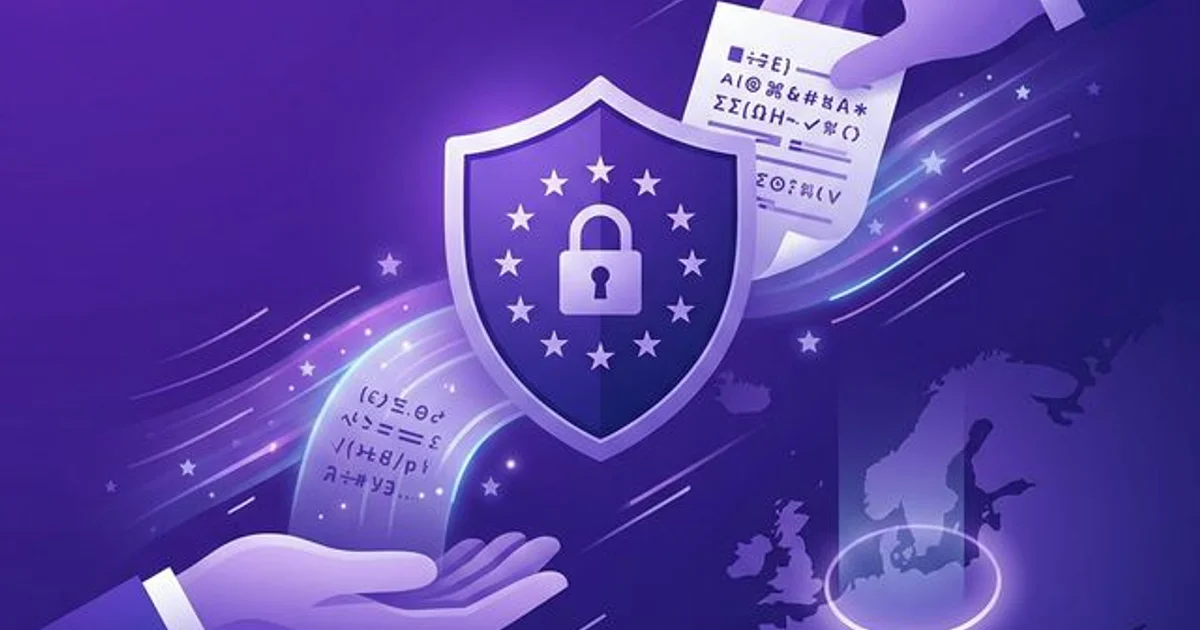
GDPR Compliant Translation Services: What EU Businesses Must Know
How to ensure your translation process is fully GDPR compliant in 2026 — data handling, NDA, and vendor selection.
Why GDPR Compliance Matters in Translation
Every time a business sends a document for translation, personal data is in motion. Employment contracts contain employee names, addresses, and salary information. Medical reports include patient health records. Legal filings reference parties by name, date of birth, and national identification numbers.
Under the General Data Protection Regulation (GDPR), any organisation processing personal data of EU residents must ensure that data is handled securely — including when it is shared with third-party service providers such as translation agencies.
This is not a theoretical risk. Since 2018, EU data protection authorities have issued fines exceeding €4.5 billion for GDPR violations. In 2025 alone, several companies faced penalties specifically for failing to ensure adequate data protection when outsourcing document processing tasks.
For businesses that rely on GDPR compliant translation services, the question is straightforward: does your translation vendor handle personal data with the same rigour you are legally required to apply internally?
Four Requirements for GDPR Compliant Translation
Meeting GDPR obligations when outsourcing translation is not complicated, but it does require specific operational safeguards. Here are the four pillars of a compliant translation workflow:
1. Data Processing Agreement (DPA)
Article 28 of the GDPR requires a written Data Processing Agreement between the data controller (your company) and the data processor (the translation agency). This agreement must specify:
- The nature and purpose of the processing
- The types of personal data involved
- The duration of processing
- The obligations of the processor regarding data security
- Procedures for data deletion after project completion
2. Technical and Organisational Measures
The GDPR requires "appropriate technical and organisational measures" to protect personal data. In the context of translation services, this means:
- Encrypted file transfer — documents should be shared via secure portals or encrypted email, never via standard email attachments
- Access controls — only the assigned translator and project manager should have access to the source documents
- Secure storage — documents should be stored on encrypted servers within the EU (or in a jurisdiction with adequate data protection under GDPR Article 45)
- Deletion protocols — source documents and translations should be deleted from all systems within a defined period after delivery (typically 30–90 days)
3. Non-Disclosure Agreements (NDAs)
While a DPA covers the legal framework, NDAs address the human element. Every translator, reviewer, and project manager involved in handling your documents should be bound by a non-disclosure agreement.
For sensitive sectors — legal, medical, financial — many businesses require sector-specific NDAs that go beyond standard confidentiality language. Your translation partner should be able to sign your company-specific NDA without hesitation.
4. Sub-Processor Transparency
Many translation agencies use freelance translators or sub-contracted specialists. Under GDPR, the primary processor (the agency) must disclose all sub-processors to you and ensure they comply with the same data protection standards.
Ask your vendor: Who will have access to my documents? Where are they based? Are they bound by the same DPA and NDA requirements?
If the agency cannot answer these questions clearly, that is a red flag.
How to Vet a Translation Vendor for GDPR Compliance
When evaluating translation agencies for GDPR compliant translation services across the EU, ask these five questions:
- Do you have a standard Data Processing Agreement? The answer should be yes, immediately available.
- Where are your servers located? Data should be stored within the EU or in a jurisdiction with an adequacy decision.
- How do you handle document deletion? There should be a defined retention period and a documented deletion process.
- Are all translators bound by NDAs? This should cover both in-house staff and freelance sub-contractors.
- Can you provide a list of sub-processors? GDPR requires transparency about all parties who handle personal data.
A compliant vendor will answer all five questions without hesitation. An agency that deflects or provides vague responses is not a safe partner for sensitive documents.
For more on selecting the right translation partner, see our guide: The Complete Guide to Certified Legal Translation in Europe.
Sector-Specific GDPR Risks in Translation
Different industries face different GDPR exposure when outsourcing translation:
Legal sector: Contracts, litigation files, and corporate governance documents routinely contain personal data of directors, shareholders, employees, and counterparties. Law firms have a professional obligation to ensure client confidentiality — a GDPR breach through a translation vendor could trigger both regulatory fines and professional disciplinary action. Medical and pharmaceutical sector: Clinical trial reports, patient information leaflets, and pharmacovigilance documents contain health data — classified as "special category data" under GDPR Article 9, requiring enhanced protections. Translation vendors handling medical documents must demonstrate additional safeguards. Financial sector: Due diligence reports, shareholder communications, and regulatory filings contain personal financial data. Financial regulators increasingly scrutinise outsourced data processing as part of operational resilience assessments. Human resources: Employment contracts, workplace policies, and employee handbooks translated for multinational workforces contain extensive personal data — names, salaries, disciplinary records, medical leave information.In all cases, the risk is the same: if your translation vendor mishandles personal data, your organisation bears the regulatory and reputational consequences.
FAQ
Does GDPR apply to translation agencies outside the EU?
Yes. GDPR applies to any organisation that processes personal data of EU residents, regardless of where the organisation is based. A translation agency in the United States, India, or anywhere else that handles documents containing EU personal data must comply with GDPR — or your organisation must ensure equivalent protections through Standard Contractual Clauses (SCCs) or other approved transfer mechanisms.
Can I use machine translation tools like Google Translate for sensitive documents?
From a GDPR perspective, sending personal data through free online machine translation tools is extremely risky. Most free tools do not provide GDPR-compliant data processing agreements, and your data may be stored, logged, or used for training purposes. If you need machine translation, use enterprise-grade tools with GDPR-compliant terms — and always combine them with human review for sensitive content.
What happens if my translation vendor has a data breach?
Under GDPR Article 33, the data processor (the translation agency) must notify you of a personal data breach "without undue delay" — and no later than 72 hours after becoming aware of it. You, as the data controller, must then assess the severity and notify your supervisory authority if the breach is likely to result in a risk to individuals' rights and freedoms. Your DPA should clearly define breach notification procedures.
---
Looking for GDPR compliant translation services in the EU? Asiatis operates under strict data protection protocols — encrypted file transfer, signed DPAs, NDA-bound translators, and EU-hosted infrastructure. Get a free quote within 1 hour → Read next: French German Contract Translation: Avoiding Costly ErrorsGet a Free Quote Within 1 Hour
Our specialist translators are ready to help. Response within 1 hour.
Get a Free Quote →Related Articles
EMA marketing authorisation translation: regulatory requirements and best practices
Translation requirements for EMA marketing authorisation dossiers: SmPC, PIL, QRD template, multilingual workflow. Best practices guide.

B2B transcreation: why translating is not enough for international marketing campaigns
Why translating your B2B marketing campaigns falls short. Real case studies, before/after examples, and the ROI of marketing transcreation for global businesses.