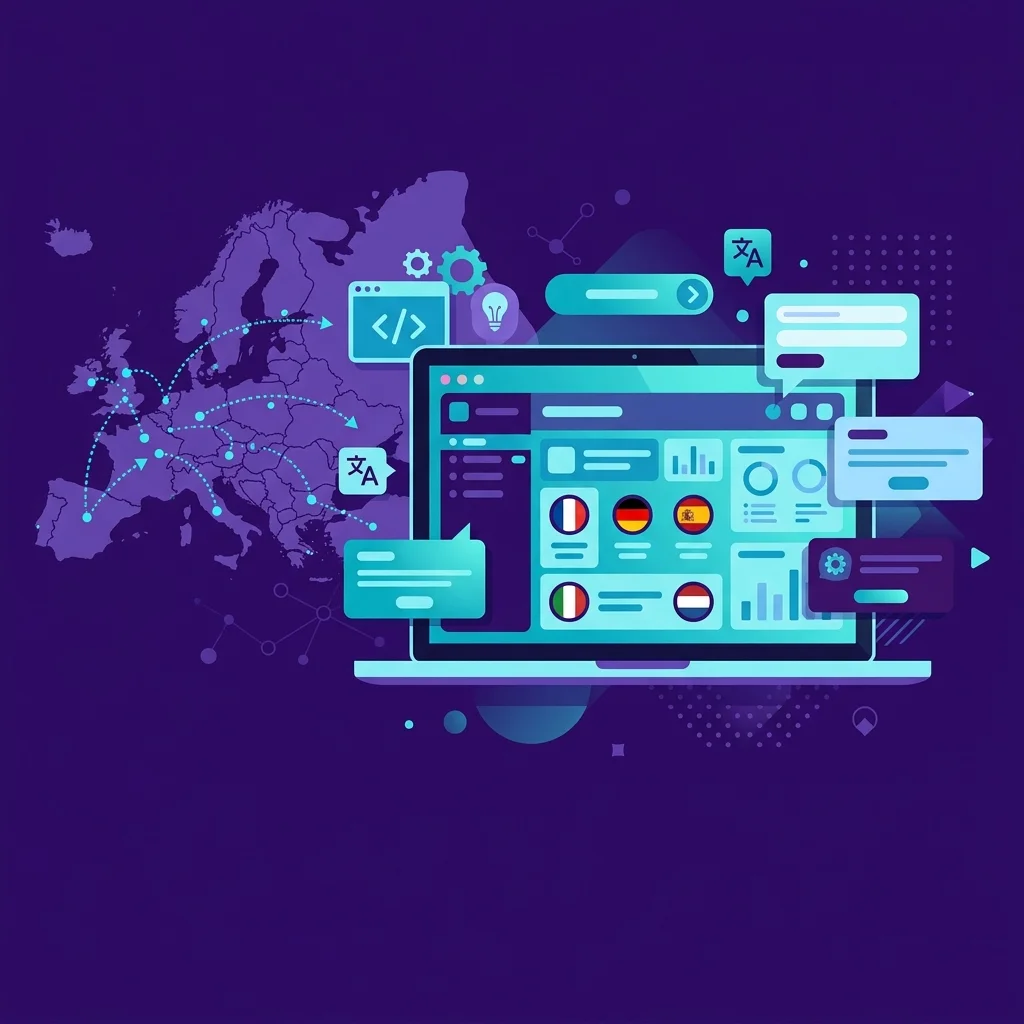
SaaS localisation for the European market: moving beyond word-for-word translation
How to localise your B2B SaaS for the European market. A guide for CTOs and Product teams on UI, GDPR, EAA 2025, and i18n workflows.
The expansion of a technological platform into new European countries structurally defines the growth trajectory of B2B software publishers. However, approaching software localisation for the European market exclusively through the narrow prism of exporting a language file regularly leads to high user friction, degraded product experiences, and outright rejection by targeted professional end-users.
European enterprise buyers expect and demand a fully native interface. The moment an application presents an ambiguous date format, an inaccurate industry-specific terminology, or a biased onboarding experience, user adoption rates plummet aggressively. This comprehensive article defines a robust methodology specifically designed for Chief Technology Officers (CTOs) and Heads of Product who need to master the genuine technical and strategic imperatives of software internationalisation in Europe—from structural i18n architecture to complex regulatory frameworks.
Why is localisation significantly different from simple translation in B2B SaaS?
The vast majority of software expansion failures stem directly from the initial confusion between literal translation and profound local adaptation. Developing a frictionless SaaS platform for a German financial controller requires a completely different level of granularity compared to merely executing a linguistic pass over a text file.
What does "localising" truly mean beyond simple text strings?
Translating an application involves converting a source text into a target language with linguistic reliability. Localising, on the contrary, demands the total adaptation of the user experience to the cultural, technical, and regulatory norms of a specific region. Within an enterprise solution, this deep adaptation firmly encompasses data formatting, approval workflows—which can vary radically depending on the local managerial culture—and navigation schemas.
A true professional localisation service must meticulously account for the visual space that text occupies within the interface. For example, a crisp "Save" command in English translates to "Speichern" in German, which considerably lengthens the button, threatens to break the CSS container, and significantly alters the overall balance of the Graphical User Interface (GUI).
What is the measurable impact on adoption and conversion metrics by market?
Disregarding local specificities actively destroys the most critical metrics of a SaaS product: the freemium-to-paid conversion rate and the user activation rate during deployment. Statistical analyses demonstrate that a strictly English-only application deployed in Italy or Spain suffers from excessively high churn rates, primarily because B2B professionals absolutely require the use of a tool in their native language when executing sensitive corporate processes. One notable enterprise software publisher measured that simply adapting their product terminology—transitioning from a generic vocabulary to the highly specific conventions required by German HR professionals—increased their user activation by a staggering 32% within a single fiscal quarter.
What are the 5 critical layers of SaaS localisation for the European market?
Addressing the IT & SaaS sector mandates that product teams intervene across multiple strata of the platform simultaneously. Only translating the login form constitutes a severely unfinished job. A complete, enterprise-grade adaptation relies entirely upon the precise identification and treatment of five distinct structural layers.
Layer 1: The user interface (UI strings, microcopy, and tooltips)
The UI represents the direct frontline of contact with the user. Isolated linguistic keys such as "Cancel", "Submit", or "Dashboard" cannot be translated blindly out of context. Tooltips or the microcopy accompanying complex web forms must reflect the exact conciseness dictated by the frontend design, all while guiding the user without resorting to unnatural phrasing. The primary technical challenge here lies in managing dynamic variables injected within sentences (e.g., "{{user_name}} has deleted {{file_count}} files"). This programmatic injection drastically alters the grammatical word order depending on the target destination language, requiring sophisticated pluralisation and gender rules within your i18n framework.
Layer 2: Dynamic content (transactional emails, push notifications, and in-app alerts)
A severely disconnected user experience emerges when an Italian client navigates a perfectly localized Italian interface, only to receive a billing push notification drafted entirely in English. Transactional emails—such as password resets, usage alerts, and subscription renewal reminders—require intense particular attention because they actively build user reassurance surrounding process security. Their translations must perfectly embrace the formal tone expected by local professionals.
Layer 3: Technical documentation and the help centre
Within large-scale European enterprises, a B2B platform is only successfully adopted if its integration can occur with a high degree of autonomy. The deep localisation of the knowledge base, quick start guides, and online product tutorials effectively relieves pressure on the technical support team. It serves as an absolute prerequisite for successful product adoption in countries possessing high technological maturity.
Layer 4: Embedded legal compliance (T&Cs, privacy policies, and consent flows)
A software application marketed and sold across European jurisdictions cannot operate without securing adequate legal validations from its users. Consent flow pages, cookie banners, and the acceptance of the Terms and Conditions (T&Cs) require an absolute level of linguistic and legal strictness. A vague or imprecise legal terminology concerning data consent directly exposes the SaaS publisher to severe regulatory action and crippling financial penalties.
Layer 5: Product marketing (landing pages, onboarding sequences, and changelogs)
Initially attracting the user necessitates highly optimised and persuasive content that relies heavily on integrated SEO localisation. Dedicated landing pages and the virtual onboarding sequences upon first launch require a creative transcreation approach to ensure absolute alignment with the commercial context, search intent, and purchasing behaviour of each distinct European market.
Which European regulatory constraints must be integrated into your localisation?
The European Union imposes stringent rules upon software publishers governing precisely how software data is displayed and how digital consent must be formulated.
GDPR: User consent, cookie banners, and stringent privacy messaging
The collection of user consent must be formulated without any degree of ambiguity across all countries of implementation. Explanatory messages outlining the collection of personal data within the software must necessarily rely on specialists who operate natively within the sphere of GDPR compliance translation. Using a prompt generated by a generalist AI model heavily risks introducing legal ambiguities that could invalidate the consent entirely under EU law.
The European Accessibility Act (EAA) 2025: Concrete linguistic implications
Starting in June 2025, the European Accessibility Act (EAA) mandates that digital products and services deployed within the EU comply with extremely rigorous accessibility requirements (broadly equivalent to the WCAG 2.1 AA standard). From a linguistic perspective, the EAA notably imposes alternative textual transcripts for all media assets and demands absolute clarity for all error messaging. Hidden descriptive tags (such as "alt" attributes or ARIA labels) must equally undergo precise professional translation to ensure that screen readers and voice assistants correctly guide a visually impaired Dutch or Spanish user without disorientation.
Local formatting structures: Dates, currencies, addresses, and decimal separators
The decimal point, an Anglo-Saxon standard (1,000.50), systematically becomes a comma across the vast majority of European soil (1 000,50). The structural order of elements within a postal address differs fundamentally between France and Germany. Flawless localisation for the EU zone requires dynamic programmatic formatting that allows the raw data of the software to bend natively to these conventions without requiring manual intervention from the backend developer.
How should you technically manage i18n files, translation memories, and CI/CD?
Integrating linguistic processes into a modern, asynchronous development cycle strongly demands the standardisation of data transmission flows.
JSON, XLIFF, or PO: Which format suits which development workflow?
The vast majority of modern frontend internationalisation software libraries (such as i18next, react-intl, or vue-i18n) rely on key-value pair structures.
* JSON: Highly pedagogical and structured (allowing hierarchy via nested objects), JSON is utterly ubiquitous in the development of modern web-based SaaS platforms.
* PO (gettext): Utilised massively within the open-source ecosystem and legacy frameworks, it permits the relatively easy identification of plural strings.
* XLIFF: The standardised industrial approach, based firmly on XML, which is universally favored by all tools within the language industry. It contains all the necessary informative metadata tags regarding the character string without running the risk of deleting or corrupting the initial code structure.
How can you integrate translation into the sprint without blocking releases?
The Continuous Integration / Continuous Deployment (CI/CD) cycle adapts very poorly to hard stops required for translation delivery. The implementation of synchronised workflows, where new strings are automatically pushed towards a Translation Management System (TMS) via API, ensures that SaaS localisation strictly follows the Agile methodology of the product team. Once the strings are validated by linguists, they are pulled back into the repository via API requests without requiring any manual operation or copy-pasting by a software engineer.
Why does surface-level localisation fail in European markets?
Treating linguistic variables as a simple, automated step generates a final product completely devoid of internal consistency and user empathy.
B2B industry terminology: A British ERP is not a German ERP
Accounting terminology or human resources jargon holds entirely dissimilar semantic boundaries across borders. A specific legal concept or a contractual status appearing within your software’s interface will frequently possess no literal equivalence within a foreign statutory system. The linguist charged with the localisation must therefore proceed with a highly precise cultural anchoring to select the exact term validated by legal and financial professionals operating in that heavily targeted country.
Formality and pronouns: Conventions that alter the entire user journey (DE Sie, FR vous, ES usted)
The expected institutional distance between software and user is not uniform. A Finnish scale-up might develop a highly informal user journey using casual pronouns. Introducing this overly friendly tone into Germany—without adapting to "Sie", the formal plural marker of respect—will unquestionably irritate a corporate financial target audience. The same rule applies to the adaptation of regional variants, such as the use or omission of the pronoun "usted" in Spanish software interfaces. The strict directive regarding tone and register must be firmly established and documented before the first string is ever translated.
How many languages should you launch initially and in what specific order?
It would be economically nonsensical for a scale-up to simultaneously localise into twenty-four European languages without having first secured proven local traction.
The strategic matrix: TAM × technical cost × linguistic complexity
The deployment order of new markets is operated according to a strict matrix intersecting the Total Addressable Market (TAM), the technical adaptation costs, and the subsequent customer support requirements generated. Creating a version for a language possessing a Right-to-Left (RTL) writing structure, or featuring notoriously complex grammatical requirements (such as Slavic languages), inherently elongates the cycles of Linguistic Quality Assurance (LQA) and UI testing.
Our recommended strategy: The 5 priority EU languages and their rationale
The standard operational procedure for European enterprises most often results in a choice of five priority languages, highly known as the FIGS+DE group: English, German, Spanish, French, and Italian.
These idioms not only cover massive proportions of professional B2B buyers within the Eurozone, but they also benefit from rich, deeply documented technical libraries. Furthermore, they do not necessitate heavy, complex typographical adaptations when compared to ideogram-based languages.
How can you structure the collaboration between product teams and localisation agencies?
The harmonisation of the global architecture stems directly from the collaborative methodology established between IT project managers, QA engineers, and language specialists.
The shared product glossary and the robust validation process
From the initial software design phase, creating a strict dictionary for the application's central terms—such as the specific title of a core feature, subscription tier editions, or proprietary modules—prevents hundreds of hours of future reworking. Asiatis, for example, strictly accompanies software deployments by aligning the foundational glossary with local product managers in order to definitively freeze fundamental semantic markers. The effort consented initially maintains total lexical and semantic robustness in the face of all future software development.
Continuous localisation: The continuous flow versus batch campaigns
Within an Agile model, each incremental feature release demands deployment fluidity. A 'Continuous Localisation' environment delegates newly added strings daily to a shared management portal, which your partners translate almost automatically. This directly opposes heavy "batch" cycles, which are now solely adapted to obsolete quarterly patch releases, although they are sometimes preferable in order to unify a major monolithic marketing launch.
What are the most frequent expansion errors made by European scale-ups?
Engineering teams must guard against numerous perceived shortcuts that inevitably lead to a jammed technical architecture and an aggressively reduced Return on Investment (ROI) for their geographical expansion.
Launching too many languages without conducting full LQA
Linguistic Quality Assurance (LQA) is the ultimate safeguard before publishing to production. A multilingual technical interface where the German translation has not been tested in-context on a mobile screen format will inevitably generate truncated words and inoperable buttons overflowing from their integration containers. Bypassing in-context proofreading undeniably translates into penalising UI/UX malfunctions that erode brand trust.
Entrusting the UI to a generalist translator without product context
An application featuring innovative functionalities cannot be formally understood by a linguist without additional usage documentation, user stories, or screenshots. Providing a short translating directive on a single undefined character key will generate a misleading user experience. Entrusting the application localisation component to a team that does not specialise its collaborators regarding algorithmic and technological expectations will directly trigger the insertion of totally absurd, context-blind phrasing.
Completely forgetting to adapt the embedded legal content
A technologically advanced application, perfectly ready to operate on the Irish or Italian market, will fail at the final commercial signature in the event of a normative dispute if its embedded terms of use (T&Cs, terms of sale) remain faithful only to the original English copy. The highly specialised treatment of regulatory blocks, executed by jurisdictional experts, irrefutably completes the rigorous compliance of this territorial deployment.
---
Are you preparing to launch your SaaS platform in Europe? Send us your i18n files and the list of your targeted markets — we will come back with a precise scope recommendation and a detailed quote within 4 hours. Get a free SaaS localisation quote in 1 hour → Read next: How to choose a legal translation agency for cross-border litigation | Comprehensive guide to certified legal translation in EuropeGet a Free Quote Within 1 Hour
Our specialist translators are ready to help. Response within 1 hour.
Get a Free Quote →Related Articles
EMA marketing authorisation translation: regulatory requirements and best practices
Translation requirements for EMA marketing authorisation dossiers: SmPC, PIL, QRD template, multilingual workflow. Best practices guide.

B2B transcreation: why translating is not enough for international marketing campaigns
Why translating your B2B marketing campaigns falls short. Real case studies, before/after examples, and the ROI of marketing transcreation for global businesses.