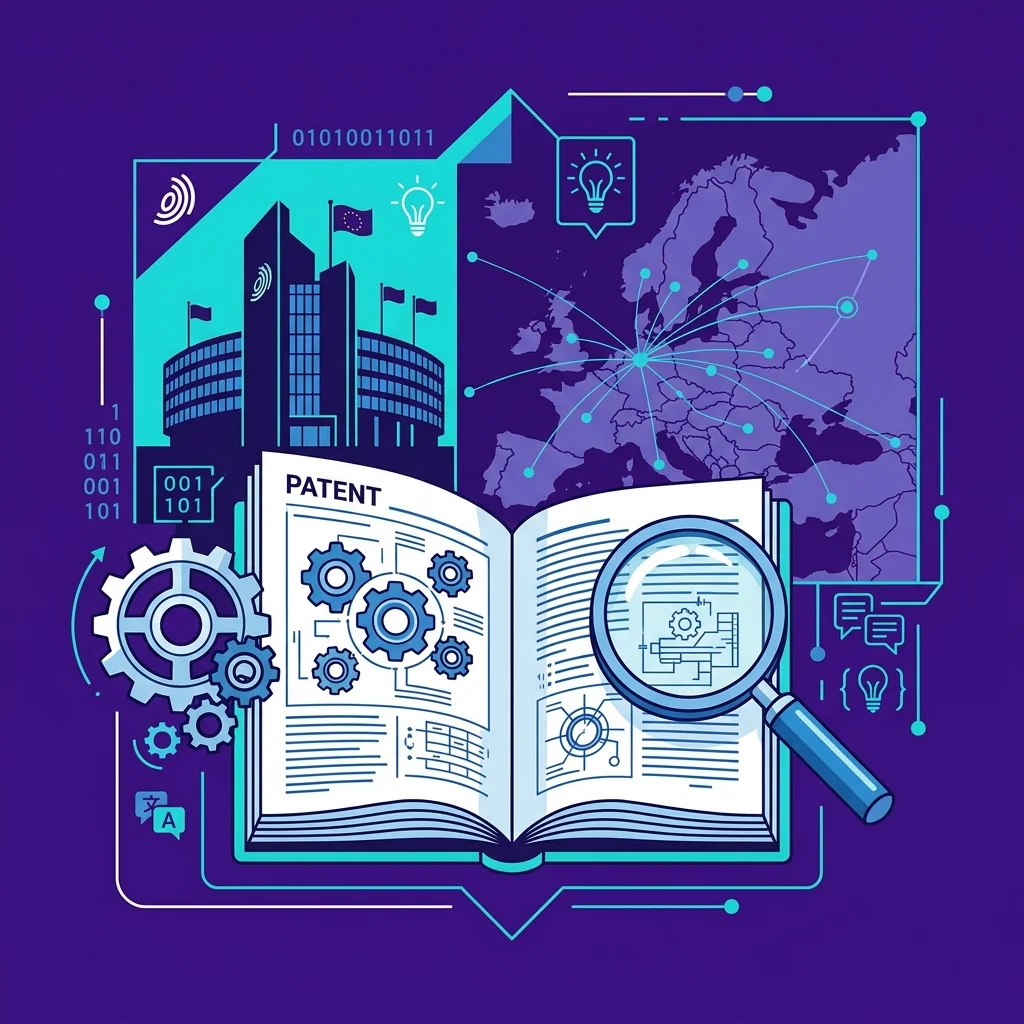
European patent translation: a guide for IP departments and specialised firms
Master European patent translation requirements. Learn about the EPO validation frameworks, the Unitary Patent's impact, and best practices for IP litigation.
Europe remains one of the most complex jurisdictions worldwide for protecting and enforcing intellectual property (IP). Between the grant procedures governed by the European Patent Office (EPO), fragmented national validation protocols, and the sweeping introduction of the European Unitary Patent, the linguistic landscape is highly demanding. For an IP director, an in-house innovation department, or a boutique IP firm, the translation of a patent application is not a mere administrative afterthought. It is a highly strategic act that directly dictates the protective scope and legal enforceability of a technological invention across multiple national courts.
This comprehensive guide breaks down the stringent operational requirements enforced by the European Patent Office and the European Patent Convention (EPC). Furthermore, it provides actionable methodologies for managing the entire validation translation lifecycle whilst securely bypassing the severe terminological traps inherent in this heavily regulated technical discipline.
Why European patent translation is a critical strategic asset
During the industrial filing process, absolute documentary precision forms the very first and ultimate line of defence for an innovative enterprise against potential infringers. Linguistic conversion is frequently, and mistakenly, viewed as a routine formality executed long after the core scientific decisions have been finalised. In reality, translation dictates the legal perimeter.
The financial risk of translation errors in patent claims
A semantic vulnerability or a structural oversight occurring during the transition from a source language to a target language fundamentally alters the legal substance of the patent. In the best-case scenario, the assigned EPO examiner detects the flaw early, which inevitably triggers costly, protracted procedural exchanges known as Office Actions. If, however, the patent is officially granted and subsequently contested by a market competitor during an opposition procedure at the EPO, or during an infringement lawsuit, an ambiguous translation frequently results in the complete loss of the industrial title within the targeted national jurisdiction. This operational risk creates an incalculable financial deficit and completely compromises the technological monopoly.
Patents versus other legal documents: an unparalleled level of precision
When compared to standard corporate documentation or traditional French-German commercial contract translation, a European patent specification demonstrates a unique hybrid nature. It is a document possessing a rigorous legal framework, yet its structural backbone is strictly scientific and technical. The required level of detail far exceeds that of standard technical translation used in general engineering. Every selected verb, pronoun, and punctuation mark redefines the exact boundaries of the commercial exclusivity granted to the applicant. A misplaced comma can widen a patent's scope to the point of invalidity or narrow it so severely that competitors can easily circumvent the protected mechanism.
The regulatory framework: European Patent Convention (EPC) and language rules
The granting of intellectual titles falls under the absolute authority of the European Patent Convention (EPC), which enforces a highly restrictive doctrine directing the entire procedure from the initial filing date through to the final official grant.
The three official languages of the EPO (English, French, German)
Official operations before the EPO—including correspondence with search examiners, written opinions, and grant notifications—revolve strictly around a linguistic triad: English, French, and German. Any applicant must submit their initial specification and conduct all ongoing procedural communication in one of these three designated tongues, which then becomes the official "language of the proceedings". However, this seemingly unified administrative front conceals further mandatory prescriptions that applicants cannot afford to ignore.
Rule 36 EPC: deadlines and translation requirements for claims
According to Rule 71(3) of the EPC, once the EPO communicates its formal intention to grant the European title, the applicant's designated representative is systematically required to submit a certified translation of the claims into the other two official EPO languages that differ from the language of the proceedings. This requirement feeds the publication databases and finalises the grant process. A strict countdown—historically representing a rigid four-month window—commences immediately. Failing to supply these verified translations before the deadline expires results in the application being deemed withdrawn, effectively aborting the entire grant procedure.
National phase: country-by-country linguistic requirements
Historically overshadowed by the formidable financial burden of mandatory full-text translations, the London Agreement significantly alleviated this weight. It allowed certain EPC member states to waive their requirement for a full local-language translation of the patent specification, provided the application was already granted in an official language they recognised. However, seamless European harmonisation regarding post-EPO validation remains incomplete.
Comparative table: linguistic validation requirements across Europe
The following table synthesises the prevailing linguistic requirements across Europe immediately following the publication of the European Patent Bulletin:
| Validation country (EPC) | Local language requirements | National phase deadline | Specific jurisdictional practices |
| :--- | :--- | :--- | :--- |
| Germany | No translation required if granted in EN/FR (London Agreement). | 3 months | Submitting claims locally in German is highly recommended due to regional court practices during litigation. |
| France | Complete exemption if filed in one of the three EPO languages. | 3 months | Complete flexibility and full adherence to the London Agreement, clarified officially by the INPI. |
| Spain | The complete specification MUST be translated into Spanish. | 3 months | Not an original signatory of the agreement; a highly certified, full-text translation remains an absolute requirement. |
| Italy | Claims only if the source is English. English + Italian otherwise. | 3 months | The UIBM protocol remains demanding, functioning in synergy with specialised IP boutiques. |
| Netherlands | Translation strictly limited to claims into Dutch. | 3 months | Full procedural simplification granted by the Netherlands Patent Office. |
| Poland | Full translation of both the description and the claims into Polish. | 3 months | Extremely strict enforcement, implying a heavy workload following mass validations on grant day. |
| Austria | No full translation required if English or French is the grant language. | 3 months | The Patent Office exclusively conducts administrative hearings in German. |
| United Kingdom | Full translation not required; complete UKIPO exemption. | 3 months | Total EPC effect maintenance remains in place continuously despite the post-Brexit operational landscape. |
Strict validation deadlines and the cost of non-compliance
Across virtually the entire jurisdictional spectrum, the entity holding the industrial right is granted a restricted window of merely three months post-grant to approach national authorities. Successfully passing these bureaucratic hurdles flawlessly is critical. Any delay in submitting the required linguistic dossiers is sanctioned by the outright forfeiture of the European patent effect in that specific target market, transforming a heavily funded innovation into public domain material.
The specific pitfalls of translating patent claims
Drafting the gold standard of IP protection requires a fastidious orthographic discipline. The claims represent the absolute backbone of IP documentation, and translating them introduces severe operational hazards.
Technical terminology versus legal terminology: a dual register
Patent claims intertwine raw scientific facts with highly codified exclusivity limits imposed by courts. Examiners and members of the Boards of Appeal are notoriously uncompromising regarding semantic shifts. The linguistic specialist responsible for executing the language transfer must continuously cross-reference accepted doctrines to preserve the precise protective scope claimed. They must avoid introducing ambiguities that tribunals classify as "added subject-matter" (Article 123(2) EPC) or an "extension of the scope of protection" (Article 123(3) EPC). This is precisely why managing applications via a dedicated legal translation service is critical.
False friends across French, English, and German patent law
The syntactic correspondences spanning English, French, and German industrial law contain severe pitfalls. Relying on standard bilingual dictionaries triggers catastrophic filing rejections:
* "Claim" vs "Revendication": Whilst "réclamation" might appear structurally close to "claim", a legal patent "claim" in French is exclusively translated as "revendication", and in German procedure as "Anspruch".
* "Embodiment" vs "Mode de réalisation": An "embodiment" does not translate to an abstract avatar. It designates a clear functional implementation of the invention, correctly translated as "mode de réalisation" (FR) or "Ausführungsbeispiel" (DE).
* "Obvious" vs "Évident": Inventive step is established by determining if a development would have been "obvious" to a "person skilled in the art". This is defined strictly as "naheliegend" in German procedure, rather than the misleading literal translation "offensichtlich".
* "Prior art" vs "État de la technique": Direct translation into French as "art antérieur" is a legacy error caused by legally untrained linguists. The founding concept is rigorously encoded by the EPO as "état de la technique" (FR) or "Stand der Technik" (DE).
The European Unitary Patent (UP): changing the translation landscape
The European community landscape has been dramatically reshaped by the active implementation of the European Unitary Patent, along with its inseparable judicial chamber, the Unified Patent Court (UPC). This framework intends to bypass fragmented national complexities by introducing a unified protection label valid across multiple adhering member states simultaneously.
The linguistic regime of the Unitary Patent
Under the strict framework of the UPC, if the unitary request is processed based on an English grant, the entirety of the original patent specification must be translated thoroughly into another official language of the participating EU member states. Conversely, an application originally granted in French automatically forces the translation of the complete corpus squarely into English. Furthermore, rather than solely translating a few condensed pages of claims, the Unitary Patent requirement often demands the translation of heavily technical documentation containing over 100 pages. In return, this single translation process enforces protection across the entire block of participating territories.
Impact on translation volumes and processing deadlines
This transition forces international IP managers to anticipate the invoicing of immense volume transfers during "Month Zero", requiring complex pages to be entrusted to translation providers within a tight window before the unitary adhesion right expires. While theoretically reducing individual post-grant translations across the continent, the budgeted processes must uphold flawlessly perfect methodological standards. Producing an imprecise translation text risks total invalidation under the scrutiny of the highly influential UPC tribunals.
Specifications, drawings, and abstracts: translating the full dossier
While the claims establish the legal borders, they are historically supported by three foundational columns that must be seamlessly adapted during national phases outside the London Agreement, or during direct filings such as Paris Convention priorities.
Detailed description of the invention
The description deeply explains the underlying technological context, the explicit deficiencies of previous systems, and the specific objectives of the newly claimed object. These sections inevitably incorporate highly advanced terminology, including proprietary software algorithms or strict pharmaceutical IUPAC nomenclature, demanding absolute scientific literacy from the linguist.
Technical drawings
The linguistic adaptation also covers the desktop publishing (DTP) integration of reference figures. This process necessitates specialised illustrators capable of replacing lettering precisely without altering the original engineering draft.
The abstract
The abstract is an initial requirement designed primarily to serve as a high-level search vector for databases such as EPOline, PATENTSCOPE, and Espacenet. Competent engineers rely heavily on these abstracts to execute immediate prior art clearance searches, making precise initial translations invaluable.
How to structure collaboration with your IP translation agency
Ensuring legal resilience requires a profound integration of file transmission processes between the corporate IP department and their accredited translation provider. Outsourcing technological risk management is only viable when supported by verifiable methodologies.
The role of a corporate glossary approved by the applicant
During the initial phase, the controlling enterprise must construct, alongside the provider's linguistic team, highly secure term-bases and immutable corporate glossaries. The IP representative must approve a bilateral firm dictionary upfront. Advanced Computer-Assisted Translation (CAT) software ensures these validated equivalents are applied infallibly across all derivative variants and patent families over the entire 20-year lifespan of the intellectual property.
The cross-checking review process: technical engineer and IP linguist
The certification of the document is executed almost exclusively through a dual-review format. First, a technical engineer specialising in the relevant thematic field examines the feasibility, engineering probity, and the integrity of the functional understanding. Following this, a certified IP legal reviewer conducts a transversal audit to verify that the necessary European legal phrasing has not suffered any factual deterioration. This dual-filtering engineering is the indispensable hallmark of leading providers, as referenced in our guide to certified legal translation in Europe.
Key criteria for selecting a patent translation provider
The evaluation must be founded upon specific variables to distinguish the ideal infrastructure from standard agencies, guaranteeing uncontested enforceability before regional jurisdictions. Including the ability to produce sworn translation required by continental courts (see our benchmark on sworn translation requirements across European countries), you must pay strict attention to the operational points highlighted below.
Rigorous sector expertise (chemistry, mechanics, pharma, IT)
The realm of molecular research operates on a vastly divergent linguistic plane than electrical engineering. For instance, the linguists assigned to a "trans-focal inhibitory polypeptide" patent must hold advanced degrees rooted closely in biochemistry. The structural capacity to segment the medical translation spectrum right down to specific transportation technology regulations is central to any respectable localisation team's methodology. At Asiatis, we exclusively assign our most highly qualified industrial divisions to these precise tasks.
EPO litigation background and knowledge of examiner procedures
A professional agency of this calibre must comprehend the jurisprudence of Munich, The Hague, and the UPC implicitly. It is necessary for them to anticipate the customary challenges raised by European opponents, recognise recurring Article 84 (clarity) objections, and align with the exact rigour demanded by the target authority regarding the innovative domain. This firmly confirms that Asiatis possesses the major strategic asset required to assist leading partner firms in the exhaustive protection of their IP portfolios.
Frequently asked questions about European patent translation
Is EPO publication generated through automatic translation?The EPO does supply a neural platform strictly for informational purposes (Patent Translate). However, the resulting output is fundamentally inadequate as legal support, entirely inapplicable during active litigation, and stripped of any binding value for nullity procedures. These decisive actions undoubtedly necessitate the validity and human guarantee of a verified expert.
Is it acceptable to file English documents with the French INPI?Although the European Patent Office accepts initial claims documents in English without resistance, national instances, such as the French national filing system, enforce the communication of a technical dossier primarily transcribed into the French system. This is an absolute necessity for any initial consideration of prior art titles carrying purely national value.
How can the budget for the national validation phase be accurately estimated?Approximations usually result from weighted estimates based on raw word counts. However, a calibrated IP structure aligns its commercial proposal through regressive pricing models applying CAT-tool translation memory. It will also factor in the precise typology of the figures in order to define and lock down an aggregate projection. This final quote must reliably include notarised certification for official homologation if required by specific states.
Does a Unitary Patent translation render existing translations obsolete?The operational option granted to an invention via the newly implemented EU Unitary request absolutely does not annul pre-existing patents granted under older, traditional validation frameworks. They co-exist seamlessly with diverse operational imperatives. Patents maintained under the "opt-out" mechanism inevitably continue to fall under the previous nomenclature, implying the historical plurality of local translations required to keep them administratively updated and enforceable.
---
Filing patents across Europe and looking for a translation partner that can handle national phases in 15+ languages? Send us your claims and we will come back with a quote within 24 hours. Get a free quote within 1 hour → Read next: The Complete Guide to Certified Legal Translation in Europe | French German Contract Translation: Avoiding Costly ErrorsGet a Free Quote Within 1 Hour
Our specialist translators are ready to help. Response within 1 hour.
Get a Free Quote →Related Articles
EMA marketing authorisation translation: regulatory requirements and best practices
Translation requirements for EMA marketing authorisation dossiers: SmPC, PIL, QRD template, multilingual workflow. Best practices guide.

B2B transcreation: why translating is not enough for international marketing campaigns
Why translating your B2B marketing campaigns falls short. Real case studies, before/after examples, and the ROI of marketing transcreation for global businesses.