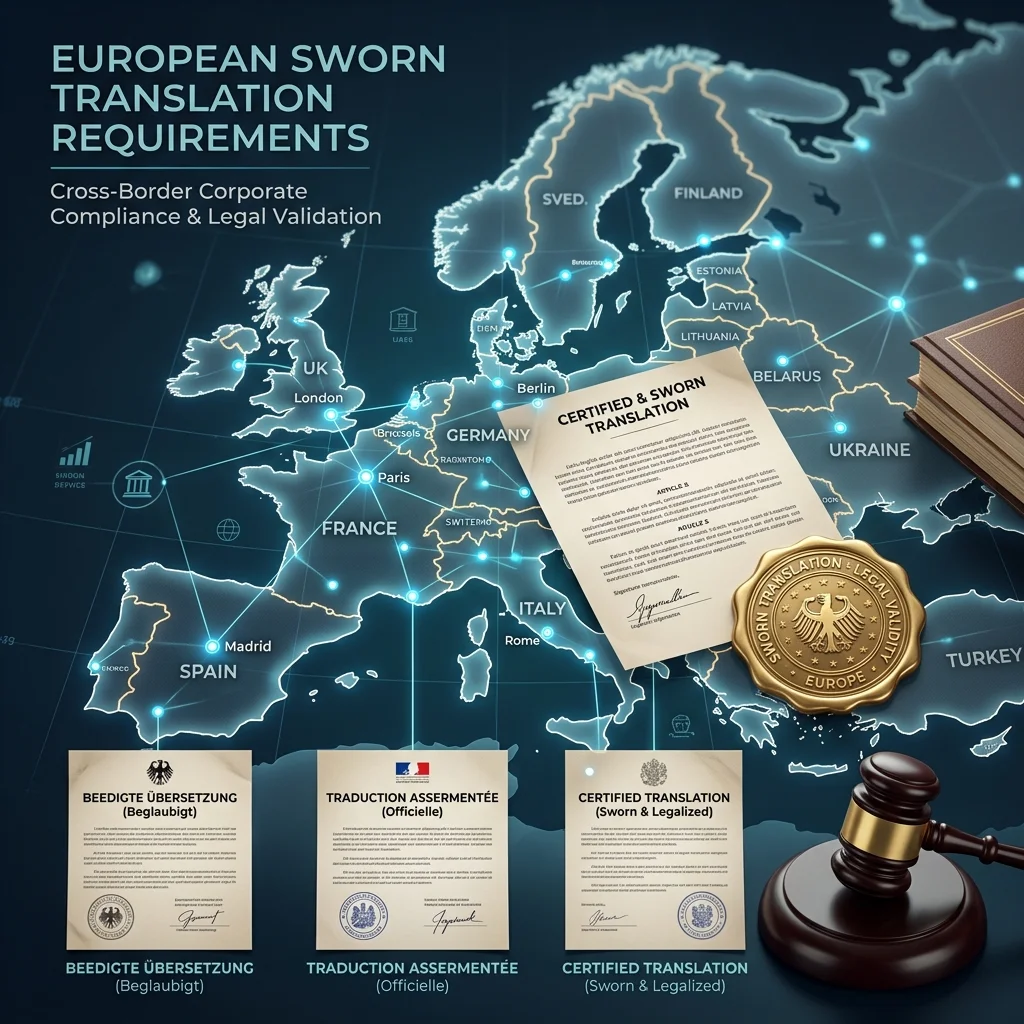
Sworn translation requirements: country-by-country guide for Europe
Comprehensive guide to sworn and certified translation requirements across 20 European countries: comparative table, Hague apostille, and national institutional systems.
The formal introduction of legal documents before foreign jurisdictions demands absolute adherence to strict documentary authentication standards. For legal departments, General Counsel, and international law firms involved in complex cross-border litigation or multifaceted corporate structuring, relying upon a precise sworn translation service does not constitute a mere linguistic formality, but rather an imperative procedural milestone. However, even within the closely integrated European continent, each member state fiercely retains absolute sovereignty over the definition and regulation of these specific rules. There is no universal equivalence, nor is there a single, unified status for the professional explicitly vested with this profound power of authentication.
Thoroughly understanding these rigid regional requirements effectively prevents the catastrophic invalidity of a master exhibit during the highly sensitive filing of a dossier. Within this highly restrictive framework, the structuring of a specialised legal translation must structurally anticipate the severe procedural particularities of the recipient country from the very first step of the legal process. This comprehensive document provides a meticulous comparative inventory of national legal frameworks, detailing the required procedures, competent authorities, and applicable protocols across 20 major European countries, explicitly designed to furnish a reliable decision-making instrument for actors within corporate and commercial law.
Sworn translation in Europe: a fragmented, non-harmonised framework
The centralised management of multi-country legal dossiers immediately collides with the extreme heterogeneity of national regulations. Senior legal professionals must constantly navigate jurisdictions that sternly demand profoundly divergent authentication methodologies.
The total absence of a unified European directive
Despite the continuous advancements of the European single market, the European legislator has not produced any unified directive harmonising the exact status of official translators. The profession remains fiercely governed by purely national codes of civil and criminal procedure. Consequently, the absolute validity of a document sworn in Country A for production before a sovereign authority in Country B depends entirely upon specific bilateral agreements, entrenched administrative customs, or occasionally, the mere compliance of the court clerk receiving the physical document. The fragmented landscape of European sworn translation thus remains a highly asymmetrical challenge, requiring significantly increased vigilance during the filing of international patents, shareholders' agreements, or notarised cross-border acquisition deeds.
Three major institutional families: the Court (FR, BE, NL), the State (DE, AT), and the Professional Body (UK, IE, Nordics)
Three distinct structural approaches can typically be observed across the continent. The first, primarily of Roman or Napoleonic inspiration (France, Belgium, and the Netherlands), forcefully entrusts the direct control and registration of practitioners to the judicial authorities themselves, operating directly via the Courts of Appeal or the Courts of First Instance. The second approach, which is heavily centralised (Germany, Austria), delegates the required habilitation to a sovereign state authority, featuring strict supervision by the Ministries of the Interior or Justice. Finally, the third family (the United Kingdom, Ireland, Sweden) relies upon a purely professional and external state regulation, frequently involving linguistic institutes mandated by the government or the formal recognition of high-level academic qualifications, existing entirely independently of any organic attachment to a court of justice.
What "sworn translation" means in practice: clarifying terminology
Semantic drift represents one of the most frequent sources of critical errors during international legal tenders. Unambiguously clarifying the lexicon is the absolute first milestone required to ensure the unyielding legal security of cross-border exchanges. This severe institutional complexity is heavily documented within our dedicated guide to certified legal translation in Europe.
Sworn vs certified vs official: strict national correspondences
"Sworn translation" (traduction assermentée) is the standard terminology forcibly applied in France, directly derived from the physical oath taken before the Court of Appeal. However, Francophone neighbours frequently employ significant variants. In Belgium or the Francophone cantons of Switzerland, the exact term "traduction jurée" operates with equal official capacity. Conversely, within Anglo-Saxon legal systems, the prevailing standard strictly dictates a "certified translation", essentially implying a formal attestation of absolute accuracy rather than a court-mandated oath. Indeed, properly distinguishing between a sworn translation and a pure notarial certification becomes strictly necessary when the receiving State rigidly imposes its very own terminology. Across the vast German-speaking sphere, this indispensable validation inherently takes the form of a "Beglaubigte Übersetzung" (certified translation).
Inherent legal value: enforceable opposability vs expected conformity
A document translated under a sworn or certified regime instantly acquires total, unquestionable legal opposability before the tribunal of the specific jurisdiction that explicitly appointed the expert. It formally, legally certifies the absolute and literal conformity of the ultimate target text with the provided original. This constitutes an inalienable probative value. Conversely, a translation that is merely "expected" by international business partners—for example, during the preliminary joint study of draft articles of association—possesses absolutely no authentic faith or legal enforceability if it is not officially sealed. The very moment the document must be subjected to an official administrative act (the registry of trades, the commercial register, or a binding court of arbitration), the formal swearing-in transforms a simple linguistic task into a legally enforceable, binding, and entirely official document.
Comparative table: sworn translation requirements across 20 European countries
The following comprehensive repository meticulously compiles the precise institutional mechanisms formally validating translations for twenty of the most dominant economic hubs in Europe. This rigorous framework significantly facilitates the management of complex, multi-jurisdictional portfolios.
| Country | Official Title of the Translator | Enabling Authority | Is an Apostille Required? | Documents Systematically Requiring Certification | Specific Procedural Notes |
|---|---|---|---|---|---|
| France | Traducteur expert près la Cour d'appel | Regional Court of Appeal | Subject to condition (EU Regulation exempt) | Articles of association, KBIS, judgements, civil registry | The format fiercely dictates a handwritten mention and the unique physical seal of the translator. |
| Germany | Ermächtigter / beeidigter Übersetzer | Landgericht (Regional Court) | Subject to condition | Patent filings, M&A deeds | Strict conceptual distinction: Beglaubigung for the written document, Vereidigung strictly for oral interpreting. |
| Spain | Traductor Jurado | MAEC (Min. of Foreign Affairs) | Depends heavily on bilateral agreements | Employment contracts, statutes, certificates of incorporation | The certified electronic signature officially issued by the MAEC is increasingly accepted. |
| Italy | Traduttore giurato / Ufficiale | Tribunale (Chamber of Oaths) | Yes, unless specific agreements apply | Notarial deeds, court summonses, powers of attorney | Physical "Asseverazione" is required. The translator must physically travel to the tribunal with specific tax stamps. |
| Portugal | Tradutor (certificação notarial) | Notaries, lawyers, or Consulates | Subject to condition | Commercial registry incorporation, agency contracts | Portugal does not possess direct sworn translators. The certification firmly passes through a legal entity. |
| Netherlands | Beëdigd vertaler | Rechtbank (Tribunal) | Frequently, outside the Benelux/EU area | Tax documents, merger files, final judgements | The WbTV maintains a staggeringly strict national register of accredited professionals. |
| Belgium | Traducteur juré / Beëdigd vertaler | SPF Justice | No, if digitally validated | Corporate balance sheets, corporate criminal records | Fully dematerialised federal system following recent legislative overhaul, featuring mandatory electronic seals. |
| Austria | Allgemein beeideter Übersetzer | Landesgericht | Subject to condition | Jurisdictional acts, intense financial litigation | An exceptionally selective registration strictly requiring the justification of continuous, high-level professional activity. |
| Switzerland | Sworn / Certified Translator | Cantonal Chancellery or Notary | Yes, almost systematically | Corporate creation deeds (GmbH, AG), civil litigation | Purely cantonal competence. The agreements and requirements differ drastically from one canton to another. |
| Poland | Tłumacz przysięgły | Ministry of Justice | Subject to EU conditions | Chamber of commerce extracts, industrial patents | The translator must maintain a rigid public "repertorium" tracing all their sealed translations. |
| Czech Republic | Soudní překladatel | Ministry of Justice / Tribunal | Subject to EU conditions | Commercial judgements, public tender dossiers | Entirely reformed regulation radically elevating the required level of probative stringency. |
| Romania | Traducător autorizat | Ministry of Justice | Subject to condition | Insolvency procedures, corporate statutes | The authorised translation generally must be distinctly over-certified by a Romanian public notary. |
| Hungary | Hivatalos fordító | OFFI (National Agency) | Subject to condition | Constitutive certificates, financial audit reports | A shared monopoly. The OFFI forcibly centralises a vast portion of the certified volume destined for the State. |
| Greece | Episimos metafastis | Bar Association / Min. Foreign Affairs | Yes, extremely frequent | Intellectual property litigation, binding contracts | Recent overhaul. Formerly the translation service of the MFA, now heavily delegated to accredited lawyers. |
| Sweden | Auktoriserad translator | Kammarkollegiet (Government) | No, if validated locally | Share purchase agreements (SPAs), Bolagsverket extracts | The rigorous qualification examination administered by the State ranks among the most selective in all of Europe. |
| Denmark | Translatør | Requirement officially abolished (free system) | N/A (liberalised, conferred severely by diploma) | Collective dismissals, fierce non-disclosure agreements | The title has been deregulated. The crucial authentication now frequently passes exclusively through the local public notary. |
| Finland | Auktorisoitu kääntäjä | OPH (National Agency for Education) | Subject to condition | Certified annual reports, corporate statutes | Mandatory renewal required every five years to successfully maintain the lucrative rights of certification. |
| Ireland | Certified Translator | ITIA (Professional Institute) | Depending upon the receiving entity | Crucial legal and deep tax compliance documents | Highly akin strictly to the UK model: the ITIA officially grants the professional status solely after a rigorous audit. |
| Bulgaria | Zaklet prevodach | Regional Tribunal or MFA | Subject to condition | Aggressive tax attestations, incorporation contracts | Frequently structurally combined with severe notarial authentication to acquire maximum public legal force. |
| United Kingdom | Certified Translator | Independent (ITI or CIOL membership) | Yes (post-Brexit, frequently required continentally) | Sworn depositions, witness testimonies, property agreements | Zero continental swearing-in. Total legal integrity rests unflinchingly upon the unalterable "Statement of Truth/Accuracy". |
Deep Dive: France — the system of the court-appointed expert translator
The rigid French framework rests entirely upon the sacrosanct independence of the judicial institution. The profound Napoleonic tradition has firmly anchored this specific prerogative deep within the code of civil procedure.
Registration on the official list of judicial experts
The official designation in France is only obtained upon the conclusion of a highly selective, multi-year path. The deeply interested party must comprehensively demonstrate proven technical skills, present an immaculate criminal record, and successfully navigate an intensely rigorous admission procedure before a commission of the Judicial Tribunal, followed subsequently by the sovereign Court of Appeal covering their geographical jurisdiction. This arduous process validates the sheer probity and immense technicality of the future occasional collaborators of the public justice service. When executing the incredibly complex European patent translation, the exquisite linguistic engineering performed by the sworn French practitioner represents the absolute key to irrefutable validation before the INPI (National Institute of Industrial Property) or significantly higher European instances.
The seal, the handwritten mention, and the total commitment of the translator
In strict accordance with current French regulations, absolutely any sworn service imposes undeniably inflexible rules of formal presentation. The translator must materially attach the physical original to their final document. They must precisely insert the mandated mention "Traduction certifiée conforme à l'original" (Translation certified true to the original), affix their physical signature, permanently inscribe a specific unique classification number known as "Ne Varietur" (explicitly designed to violently prevent any subsequent covert alterations), and finally forcefully apply an official ink seal. Any submitted document that carelessly omits the original signature or this heavy administrative mark will be immediately and irrevocably declared inadmissible by the sitting judge.
Deep Dive: Germany — the ermächtigter Übersetzer and the Beglaubigte Übersetzung
The profound Germanic approach is internationally renowned for its unparalleled rigour of execution, concentrating relentlessly upon securing absolute documentary evidence long before formally invalidating the slightest commercial dispute.
Direct habilitation by the Landgericht
In Germany, the strict supervision falls exclusively under the corresponding local jurisdiction, the Landgericht. The professional takes a highly solemn general oath directly before the residing president of the regional tribunal. Once the stringent habilitation procedure is validated, they are legally authorised to utilise the heavily protected title of "ermächtigter Übersetzer" and to officially issue "Beglaubigte Übersetzungen". During the highly sensitive processing of French-German contract translation, the imposed, unalterable seal allows for the unequivocal authentication of incredibly dense contractual clauses—a parameter that proves to be absolutely critical within the unforgiving realm of civil and commercial liability law (BGB).
Distinguishing Beglaubigung vs Vereidigung
The exquisite precision of German law rigidly imposes two distinct conceptual variants. The "Beglaubigung" refers strictly to the written attestation confirming scrupulous syntactic fidelity. The "Vereidigung", however, is exclusively attached to the physical action of the interpreter operating orally in courts of justice (beeidigter Dolmetscher). An elite service provider may hold one, the other, or the entirety of these accreditations. Within the high-stakes corporate sphere, the processing of international contracts systematically requires the Beglaubigung in order to iron-clad the probative opposability.
Deep Dive: Spain, Italy, and Portugal — the Mediterranean systems
The sovereign instances of Southern Europe have adamantly instituted protocols that sit at the absolute antipodes of Anglo-Saxon flexibility, drastically preferring highly regulated direct institutional validations.
Spain: the Traductor Jurado appointed by the MAEC
In Spain, the overarching management falls entirely to the Ministerio de Asuntos Exteriores y de Cooperación (MAEC) located in Madrid. To obtain the highly respected and coveted title of "Traductor Jurado", candidates must successfully pass a gruelling series of ministerial examinations of renowned difficulty; once passed, the title is valid without geographical limitation across all of Spain. The sheer materiality of the translation is firmly signified by the strict application of a unique seal officially registered with the MAEC. The Iberian administration has recently fluidified its complex protocols by formally authorising a highly qualified replacement electronic signature, thereby efficiently avoiding physical postal dispatches for incredibly dense, multi-volume B2B dossiers.
Italy: the strict requirement of the Asseverazione before the Tribunale
The deeply customary Italian model distinctly stands out due to its profound physical archaic nature. Italy does not maintain a simple, unified national list of sworn translators holding a "magic stamp". To properly obtain total legal approval, the executing party must accomplish what transalpine law explicitly terms an "Asseverazione". This arduous process mandates fiercely compiling the complete physical dossier, and subsequently appearing in person before the formal clerk (Cancelliere) of a Tribunale or before a sitting Justice of the Peace. There, they must materially swear, typically upon an official form heavily laden with specific tax stamps (marca da bollo), that the transcription represents the absolute and untarnished truth of the original document.
Portugal: indirect certification via a notary or consulate
The Portuguese State applies a highly derivative system that incorporates absolutely no qualification of a state-sworn translator in the strictest sense. The heavy responsibility of ultimate authentication is structurally routed via organically attached notarial offices, the official Chamber of Notaries, or fully accredited lawyers (Ordem dos Advogados). In practical terms, the linguistic professional flawlessly executes the transfer, but it is exclusively the legal instance or the commanding officer of the Portuguese Republic who formally recognises their solemn oath, ultimately producing a document legally designated as certified (certificação de tradução).
Deep Dive: Nordic countries and the Benelux — highly contrasting systems
These specific regions intelligently combine an immense flexibility of daily usage with deeply rigorous mechanisms of academic standardisation that are fiercely controlled upstream.
Sweden, Denmark, and Finland: auktoriserad translator and the State system
In Sweden, only the highly austere Council of State named Kammarkollegiet governs the fiercely protected register of the "Auktoriserad translator". The sheer volume of currently recognised graduates annually is extraordinarily low, thus ensuring an impregnable linguistic homogeneity of remarkable reliability. Denmark, conversely, has radically deregulated the appellation by abruptly repealing the monopoly of the translatør; faced with the vast vacuum created, elite legal departments now resort massively to heavy notarial certifications (Notarius Publicus). Finland steadfastly maintains the Auktorisoitu kääntäjä through the heavily centralised control of the National Board of Education (OPH), granting a total legitimacy that is strictly limited to fiercely renewable cycles of a mere five years.
The Netherlands and Belgium: beëdigd vertaler and profound Belgian trilingualism
The Benelux region centralises its processes very forcefully. The Netherlands severely regulates the provision through a specific organism, the Raad voor Rechtsbijstand (WbTV), structuring the highly esteemed "Beëdigd vertaler" register to which all entities of commerce ultimately pledge their allegiance. Its imposing neighbour spanning the Belgian sphere significantly complicates the exercise due to its deeply intrinsic trilingual essence (French, Dutch, German). A highly recent, extremely disruptive change in law in Belgium now forcefully dictates that appointed practitioners must employ a highly secure electronic signature to officially record their actions (SPF Justice), thereby entirely eliminating the endless, time-consuming physical shuttles to the registry of the courts of first instance.
The post-Brexit United Kingdom: what has fundamentally changed for certified translations
The profound political and insular enclave of the common law brings about a deeply liberal management that is diametrically antagonistic to continental, civil-law notarial dogmatism.
The sheer absence of a continentally defined "sworn" translator
The United Kingdom structurally and culturally rejects the presence of professionals officially empowered by a direct state mandate in the civilist sense of the word "sworn". An English court (such as the High Court or the Chancery Division) smoothly validates and operates exclusively with "Certified Translations". The ultimate guarantor of uncompromising control is completely delegated to the extreme professionalism and organic credibility of major corporate providers or practitioners prominently affiliated with highly structured and incredibly demanding associations such as the ITI (Institute of Translation and Interpreting) or the CIOL (Chartered Institute of Linguists).
Legal certification relies completely upon the Statement of Accuracy
When a brutal British financial dispute occurs, the required exactitude of the translation is firmly founded upon a "Statement of Truth" or a "Statement of Accuracy". This appended certificate, heavily documented by the professional, explicitly stipulates that the restitution is flawlessly true and entirely exhaustive. It rigorously details their own corporate identifiers, their physical location, as well as their elite academic titles validating the attestation. It is the unyielding formal commitment of the professional (or of their agency director) that constitutes the sole lever of judicial action in the event of a highly damaging fault detected by an aggressive defence.
The complexities of cross-recognition between the EU and the UK
Since the severe structural shift of 2020 following the strict application of Brexit, the required production in a European court of deeds executed exclusively in the United Kingdom experienced a briefly chaotic phase, provisionally imposing the urgent need to proceed with heavy notarial over-certification coupled with additional, burdensome oaths. Nevertheless, the current bilateral frameworks have deeply stabilised the procedures primarily thanks to the continuous, unyielding application of the conventions of the apostille, nonetheless forcing plaintiffs to meticulously avail themselves of the undeniable existence of the formally approved "statement".
The Hague Apostille: when is it strictly necessary in addition to the swearing-in?
The precise comprehension of the phenomenon known as "over-certification" fundamentally determines the successful, timely completion of an incredibly complex binational approach. This arduous process proves absolutely indispensable when facing the severe diplomatic requirement of ensuring total conformity.
The 1961 Hague Convention and its signatory countries
The constitutive, groundbreaking text of the 1961 Hague Convention established a drastically reforming mechanism specifically aimed at abolishing the suffocating, unlimited chains of diplomatic and consular real-world legalisations. The "Apostille" explicitly comes to formally attest, not the intrinsic veracity of the fundamental content of a document, but rather it is inscribed fiercely on the back or upon an annexed document (allonge) of the paper solely to confirm the absolute authenticity of the unique signature of the specific official who signs it. This mechanism has allowed for the dramatic acceleration of massive cross-investments among the hundred or so adhering States within and far beyond geographical Europe.
Applying the Apostille on the translation vs on the source document
The severe ambiguity frequently resides in targeting the exact location of this attestation. In an immense number of transnational B2B schemas, the legislation rigidly obliges the validation of the apostille directly upon the source document (the initial KBIS or the native acquisition deed). Once this crucial verification is successfully acquired, the final, decisive action of the translator officially certifies the textual content while also fully integrating the specific mention of the pre-existing apostille. Concurrently, particular entities aggressively demand specifically an "apostille of the translation": in this complex instance, a superior court clerk formally apostilles the very signature of the expert who affixed their seal, which instantly confers an irrefutable legal proof for the mandating party operating intensely abroad.
Total exemption via EU Regulation 2016/1191 between Member States
To adequately alleviate a deeply crippling bureaucracy for internal business actors within the Union, the incredibly fundamental EU Regulation 2016/1191 established, effective February 2019, the absolute end of the apostille for the routine exchange of highly specific, vital public documents within the bloc of the 27. Certain extremely sensitive administrative acts, along with diverse directives concerning executive criminal records, now benefit immensely from a fluid circulation utterly devoid of any over-legalisation, thereby significantly lowering the incredibly steep procedural costs faced by corporations operating with heavy inter-State volumes.
How to strategically organise the sworn translation of a multi-country dossier
The anarchic, fragmented outsourcing of deeply critical documentary work invariably breeds severe structural drifts: an unacceptable explosion of judicial deadlines, gross sectorial heterogeneity, and intense consular over-billing for the mandating enterprise.
Centralising via a single agency vs employing local translators per country
Recklessly entrusting your high-stakes legal advocacy to ten distinctly independent freelancers scattered across ten different countries imposes an absolutely unacceptable logistical overload upon the legal operations (legal ops) secretariat. However, the unifying action lying firmly at the heart of truly specialised initiatives allows for highly serene, deeply secured delegation. Actively choosing how to efficiently choose a legal translation agency for cross-border litigation fundamentally entails verifying its raw capacity for logistical consolidation: a single elite agency flawlessly coordinates its private bedrock of officially registered correspondents simultaneously enlisted upon the rolls of the tribunals in Madrid, Belgium, or Rome directly from an impregnable single logistical hub located in Paris.
The massive systemic advantages of a single point of contact
The tactical securing of an exclusive point of contact considerably fluidifies the entire contentious strategy. The lead auditor strictly informs only a single senior project manager of the extremely rigid contentious deadlines that absolutely must be respected. The heavy invoicing is flawlessly centralised under a single SIRET identifier with an entirely uniform quotation in euros, rather than bleeding through multiple, highly dispersed financial flows. Furthermore, the immense criminal and legal liability vehemently remains knighted to the sole contractor (the agency), effectively limiting the terrifying systemic flaws inherent to the leakage of probative capital. Moreover, as deeply detailed in our exhaustive reverse-engineering study regarding the automated usage of algorithms in DeepL vs human translation for international contracts, only a single, supreme quality manager securely ensures that incredibly strict contractual clauses do not suffer from completely unfounded variations.
The power of Translation Memory on recurrent corporate dossiers
The truly unanswerable argument acting strongly in favour of absolute consolidation is pristine archival management. A significantly unified reference provider heavily and technically integrates deep-tech Computer-Assisted Translation (CAT) software firmly within a high-cybersecurity environment, aggressively capitalising the exact history of every single processed paragraph from all previous contracts or shareholders' agreements. The incredibly potent technological reuse of an anterior, legally validated terminological formulation generates unshakeable absolute coherences from one country to another, all while rigorously alleviating the massive scale of proportional billing throughout the sheer length of future trials or incredibly dense corporate developments.
FAQ: frequently asked questions regarding sworn translation in Europe
Is a sworn translation executed in France legally valid in Germany?
The validity is absolutely not automatic within the fierce commercial law of contracts. Although beautifully validated in the French Court of Appeal, Germany fiercely retains the sovereign faculty to simply refuse a summons if this transcription is not distinctly endorsed by a practitioner (ermächtigter Übersetzer) officially listed in the region of establishment of the specific competent Landgericht. It is highly advisable to urgently require strict German certification for major documents or, at the absolute minimum, to ensure it is heavily apostilled in its source format prior to any transfer.
Is a completely new sworn translation required for strictly every procedure?
No. The officially sealed document permanently retains its inherent probative validity if the corresponding original text remains completely and utterly unaltered. However, highly recent commercial incorporation registers or the sudden updating of sensitive tax documents technically and legally impose that an entirely new translation be de facto certified upon the second heavily modified KBIS or registry extract.
Can an existing translation be sworn retroactively?
A retroactive certification remains technically completely unacceptable across the vast majority of severe European jurisdictions. The judicial signatory solemnly and legally attests that they have personally and directly taken cognizance of the physical original and subsequently directed or physically executed the cognitive linguistic act themselves. This rigidly proscribes absolutely any blind recovery, swift verification, or so-called "certification of compliance" of a text heavily generated by another without the corresponding, incredibly rigorous forensic analysis.
What are the standard lead times for a complex sworn translation?
The rigid legal protocols governing authentication fatally and inevitably prolong the required time for restitution. The absolute obligation for the professional to physically print the vast originals, rigorously number, materially sign every single sheet, and then immediately dispatch it via highly secure parcel or deliver it strictly by hand, significantly increases a normal deadline by 24 to 72 hours strictly depending upon the overall volumetry. In certain exceptionally rigid local jurisdictions advocating the handwritten signature of the clerk (notably deep within Italy), the required deadline abruptly lengthens specifically due to the mandatory physical administrative appointments.
---
Do you have an incredibly complex legal dossier that rigorously demands sworn translations across multiple European countries? A single highly accountable interlocutor, a single comprehensive quote, with absolutely all required jurisdictions securely covered. Send us your exact list of documents and the precise target countries. Request your multi-country quote → Read next: Choosing a legal translation agency for cross-border litigation | Guide to certified legal translation in EuropeGet a Free Quote Within 1 Hour
Our specialist translators are ready to help. Response within 1 hour.
Get a Free Quote →Related Articles
EMA marketing authorisation translation: regulatory requirements and best practices
Translation requirements for EMA marketing authorisation dossiers: SmPC, PIL, QRD template, multilingual workflow. Best practices guide.

B2B transcreation: why translating is not enough for international marketing campaigns
Why translating your B2B marketing campaigns falls short. Real case studies, before/after examples, and the ROI of marketing transcreation for global businesses.